









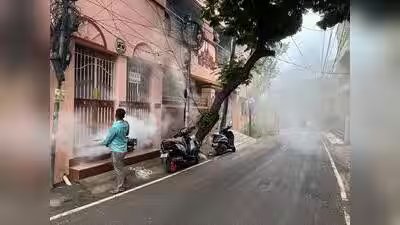
Chennai: With Chennai logging at least 65 dengue cases in July so far, Greater Chennai Corporation has ramped up vector control measures by launching door-to-door fogging, and domestic breeding checks.GCC’s chief vector control officer S Selvakumar said dengue season usually began in June and peaked in Nov, before going down by Feb. “We want to have an early intervention. We have deployed one domestic breeding checker (DBC) for 500 houses. The city has 2,073 DBCs,” he said.The civic body has surveyed 8,000 new construction sites where work has not begun yet. “Water will stagnate in these spots, and that is enough for Aedes mosquitoes to breed. We have told our DBCs to inspect these sites, and fine the owners,” he said. The GCC’s buildings department has instructed assistant engineers to issue a notice to builders if construction activity does not occur for 15 days.Besides, the civic body has begun inspections in Tamil Nadu Urban Habitat Development Board complexes where residents store water in open drums. “In most TNUHDB colonies, water is stored in open drums connected to 1hp motors. These motors can suck larvae up to the overhead tank too. We have been instructing residents to close the drums,” he said.Last year, GCC on average reported 10 cases a day in July. This year, though, only 4 cases a day have been reported so far. “But we cannot take it lightly. We want to keep the trend low for the coming months too,” said Selvakumar.The civic body has also identified hotspots near the banks of the Cooum, Adyar river and Buckingham Canal, to target Culex mosquitoes, which grow in sewage water. Unlike Aedes, which grow in fresh water, Culex mosquitoes cause Japanese encephalitis and West Nile fever.GCC commissioner G S Sameeran has issued a circular directing officials to carry out fogging and intensify larvicide spraying in waterways using vehicle-mounted sprayers. He has also asked zones to maintain adequate stocks of larvicides, insecticides and necessary equipment.Domestic breeding checkers have been instructed to refer locals who catch a fever to the nearest urban primary health centre and alert civic officials. Sanitation and vector control officials have been directed to monitor breeding control activities, identify hotspots, and submit daily reports on action taken to the commissioner.