









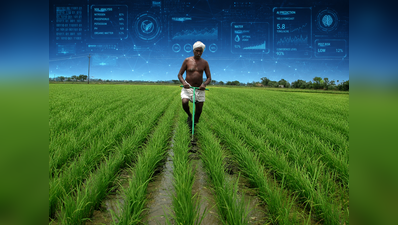
S ChandramohanIndia’s farmers are among the hardest-working entrepreneurs in the world. Yet they make some of the most consequential business decisions with the least information. Manufacturers know their inventories, demand forecasts, financing options and customer pipeline. Retailers track sales in real time. An airline uses predictive analytics to price every seat. Farmers, by contrast, often decide what to plant, when to irrigate and where to sell using fragmented advice, delayed market signals and intuition. That is not a failure of farming. It is a failure of intelligence infrastructure.
CJP Jantar Mantar Protest Updates
The next agricultural revolution needs to be driven by providing every farmer with timely, trusted intelligence to make better decisions.A large proportion of farmers still depend on local input dealers, neighbouring farmers and traditional practices.Govt extension officers are intended to bridge this gap, but in many areas their capacity to provide field-level, crop-specific guidance is limited.The result is excessive fertilizer use, incorrect pesticide application, poor irrigation scheduling, lower yields and higher production costs. This is not because farmers are unwilling to learn. Many seek practical, timely advice.The absence of crop planning is perhaps the biggest structural weakness. Suppose turmeric prices are exceptionally high this year. Next season, thousands of farmers switch to turmeric. Two years later, production surges, prices collapse. The same cycle has happened with several crops.We don’t advise farmers that their district has too much chilli, or that planting sesame or pulses the following year is likely to be more profitable.Imagine if farmers received district-wise, data-driven advisories based on expected acreage, rainfall forecasts, export demand, domestic consumption and global prices; it would be transformative.Many export consignments are rejected due to pesticide residues above permitted limits, incorrect chemical use, poor traceability, contamination and improper grading. The problem is rarely the farmer alone. Sometimes aggregators mix produce from multiple farms. Records are poorly maintained, or exporters themselves adopt wrong practices, making it impossible to identify the source of contamination. One farmer’s mistake can affect an entire shipment. One shipment can damage India’s reputation in an export market. This is fundamentally a quality governance issue.European Union’s residue limits, for example, require a pre-harvest interval of 21 days if there is intent to export.Another real problem is fragmentation. The scientist knows one thing. The agriculture university knows another. The extension officer knows something else. The weather department has different information. Exporters understand global demand. Banks know credit history. Processors know future requirements. Retailers know consumer trends. None of this knowledge reaches the farmer in an integrated way.India lacks a national agricultural intelligence network.Imagine the impact where every farmer receives personalized, continuously updated advice based on soil health, weather forecasts, satellite imagery, pest surveillance, local water availability, market demand, export opportunities, warehouse capacity, logistics availability, expected prices, govt schemes, crop insurance, carbon credits and regenerative farming incentives on one platform.Instead of saying “apply pesticide”, the system tells them that the crop in their village has a 72% probability of fungal infection in five days and that applying a particular fungicide at a certain dosage is necessary only if symptoms appear. This is where AI becomes critical. Every morning, farmers should receive information on whether rain is expected in 48 hours, whether irrigation would need to be postponed by 48 hours, whether a nearby textile mill is offering a premium for longer-staple cotton, and so on. Can we attempt unified digital public infrastructure for agriculture, similar in philosophy to UPI?It could include farmers’ digital identity, which would have the name and address, farm location, survey number, land size, irrigation source, crops grown, machinery owned, livestock and FPO membership and field intelligence, where the platform continuously gathers satellite imagery, rainfall, soil moisture, temperature, humidity, NDVI vegetation index, pest surveillance, disease outbreaks and groundwater levels, so the farmer would not have to collect it manually.Another missing layer it could include is agronomic intelligence with specific advisories on fields. Market and financial intelligence would help to connect mandis, warehouses, processors, exporters, retailers and logistics providers, giving information such as when demand is expected to rise, and crop loan due dates, subsidy eligibility, credit ratings and govt schemes. Instead of the farmer applying, the system recommends.Knowledge intelligence is perhaps the biggest revolution, where the farmer gets a personal AI agronomist that speaks all languages.But who builds it? Not govt alone. Think of it like UPI. Govt builds standards. Universities contribute knowledge. ICAR develops agronomic protocols, state agriculture departments provide extension content, start-ups build applications, banks integrate finance, insurance companies integrate claims, exporters provide demand forecasts and processors publish procurement plans. Private companies have a wealth of information on agronomic practices and they can also contribute. Everyone connects through APIs. AI allows one expert to guide 10 lakh farmers. The officer becomes teacher, trainer and supervisor.The platform should not wait for questions. It should predict problems. This is preventive agriculture.That makes it one of the highest-return public digital investments India could undertake for the benefit of farmers who toil for us every day with the least returns for themselves.(The writer is director and group president – corporate affairs, TAFE Ltd)