









Venezuela — hit by twin earthquakes on June 24 — is struggling to build itself back up. With official rescues dropping dramatically, the death toll has risen to 1,943 and the number of injured has almost doubled to 10,571, according to latest information.
From India sending a field hospital under Operation Amistad and two IAF C-17 Globemaster aircraft with 66 tonnes of aid, to the U.S. deploying 900 personnel, international aid continues to pour into the country.
Meanwhile, aid groups warned that Venezuela’s fragile healthcare system is being pushed to its limits nearly a week after two powerful earthquakes, with damaged and understaffed hospitals getting overwhelmed by the injured and infectious diseases flaring in the disaster zone. Among the living, a humanitarian crisis is unfolding. United Nations agencies expressed concern about the health effects of thousands of displaced people sleeping for days in the open or in crowded, unsanitary shelters.
Venezuelan officials say that more than 15,800 people have been affected by the earthquakes — a figure that reflects the official number of displaced people, U.N. refugee agency spokesperson Carlotta Wolf said. Without access to toilets, showers or soap, displaced Venezuelans have also become increasingly vulnerable to the outbreak of preventable diseases like measles, given the population’s low vaccination rates, Lindmeier said, adding that conditions are ripe for waterborne infections such as dengue, yellow fever and malaria to spread. (Text: AP)

Photo:
AP
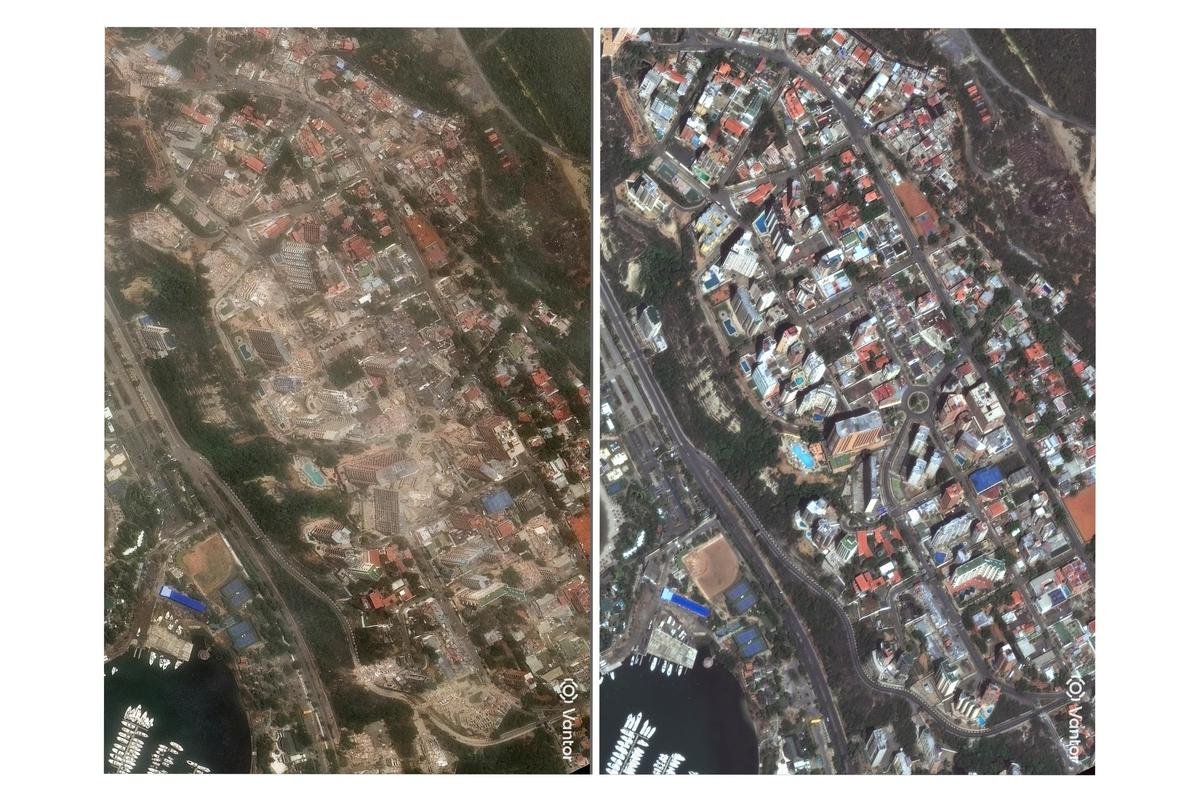
These images provided by Vantor show the before and after of the earthquakes that struck on June 24, 2026, in Playa Grande, Venezuela. On the right are buildings as they appeared on June 15, 2026, and on the left are collapsed buildings from the day after the earthquakes, on Thursday, June 25, 2026. (Satellite image ©2026 Vantor via AP). Among the living, a humanitarian crisis is unfolding. United Nations agencies estimated on June 30, 2026, that the earthquake amassed 1.2 million tons of debris of destroyed buildings and belongings.

Photo:
AP
Damaged buildings stand in Catia La Mar, Venezuela, a day after an earthquake and several aftershocks struck the city on Thursday (June 25, 2026). With the window for finding survivors shrinking quickly, Venezuelans combed through the ruins of buildings toppled by last week’s powerful back-to-back earthquakes, and attention turned to the country’s humanitarian crisis, which could persist for years.

Photo:
AP
Patients lie outside a hospital evacuated after it was damaged in an earthquake in Catia La Mar, Venezuela on June 25, 2026. Meanwhile, the number of official rescues has dropped dramatically in the last three days, the government said, from 5,380 people saved in the first two days after the quakes to just four people found alive June 29, 2026, by authorities.

Photo:
AP
Rescue workers gesture for silence as they search for survivors in a building that collapsed after earthquakes struck Caracas, Venezuela, a day earlier on June 25, 2026. The prime window for finding earthquake survivors is typically 48 to 72 hours, but it is possible to survive longer depending on factors such as temperature and access to water or food.

Photo:
AP
People camp in the street the night after the earthquake struck Caracas, Venezuela on June 25, 2026. Without access to toilets, showers or soap, displaced Venezuelans have also become increasingly vulnerable to the outbreak of preventable diseases like measles, given the population’s low vaccination rates, World Health Organisation spokesperson Christian Lindmeier said.

Photo:
Reuters
U.S Marine Corps military aircraft on the tarmac as U.S. teams are deployed to support relief operations following earthquakes in Venezuela. Meanwhile, more than 100 people just deported from the United States were being held in a hotel when earthquakes struck Venezuela, setting off a scramble to find survivors and bodies buried in the rubble, according to survivors. The U.S. ran 12 deportation flights to Venezuela in May, operating three days a week, according to ICE Flight Monitor. Deportation flights to Venezuela resumed in February 2025 after a 13-month pause.

Photo:
Reuters
A satellite image shows an overview of El Junquito, Venezuela, June 26, 2026, in the aftermath of earthquakes. The government puts the death toll at over 1,900. Experts say that is a significant undercount as more bodies are hauled from the rubble every day and morgues struggle to handle the influx.

Photo:
PTI
Indian Air Force C-17 Globemaster III aircraft arrives at Maiquetía International Airport, Caracas, carrying 66 tonnes of humanitarian aid- including an Indian Army Field Hospital, over 35 tonnes of relief supplies, medicines and medical equipment, and two BHISHM Cubes, for Venezuela as part of post-earthquake relief efforts on June 28, 2026.

Photo:
AP
U.S. and French search-and-rescue personnel work to reach earthquake survivors trapped in the rubble in La Guaira, Venezuela on June 28, 2026. Many of those displaced in the hardest-hit state of La Guaira, just outside the capital of Caracas along the coast, are suffering from widespread food shortages, WHO spokesperson Christian Lindmeier said.

Photo:
Reuters
Aerial view of collapsed buildings in Caraballeda, La Guaira state, Venezuela, on June 30, 2026, following earthquakes. An increased presence of nongovernmental organisations was noticeable on June 30 in La Guaira and adjacent communities, with tents from the Red Cross, the World Food Programme and other organisations set up on sidewalks, waterfront esplanades and athletic facilities.

Photo:
AP
Rescue workers react as they conduct search and rescue efforts to reach potential survivors on on June 30, 2026, after earthquakes struck La Guaira, Venezuela. According to the government, last week’s earthquakes damaged or otherwise compromised 38 hospitals nationwide. WHO said it so far has evaluated 21 of those facilities, three of which are no longer operating. Another six have sustained damage and the rest are now buckling under the influx of injuries.

Photo:
Reuters
Rescuers work at the site of a collapsed building, in the aftermath of earthquakes, in La Guaira, Venezuela on June 30, 2026. With the government tight-lipped about victims and survivors and offering no official count of missing people, ordinary Venezuelans are struggling to find relatives.

Photo:
Reuters
Yohancy Gil, 24 and her husband Sergio Guanipa, 30, stand on rubble as they wait for news from rescue teams looking for their children under the rubble at the site of a collapsed building in the aftermath of earthquakes, in La Guaira, Venezuela on June 30, 2026. Many have turned to WhatsApp groups and nongovernmental digital databases to report their loved ones as missing. One such registry listed at least 43,220 people as missing.

Photo:
AFP
View of a damaged hotel at a beach in Caraballeda, La Guaira state, Venezuela, on June 30, 2026, following the June 24 twin earthquakes. In his daily televised casualty update, Jorge Rodríguez, brother of interim President Delcy Rodríguez, said that the official toll stood at 1,943 people killed and 10,571 injured as of June 30, 2026, urging the public to share only government information.

Photo:
AFP
A U.S. Marines helicopter overflies a quake-hit area in Caraballeda, La Guaira state, Venezuela, on June 30, 2026, following the June 24 twin earthquakes. NASA estimates that nearly 59,000 buildings have been damaged or destroyed by the earthquakes, which would put the number of people affected by the quakes in the hundreds of thousands. The U.N. children’s agency, UNICEF, on June 30, 2026, said 6,80,000 children are in need of humanitarian assistance nationwide.
Published – July 01, 2026 01:36 pm IST

