








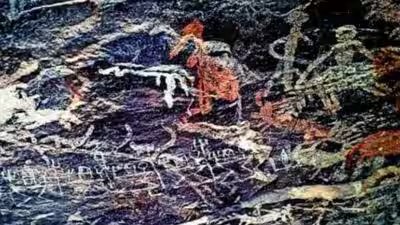
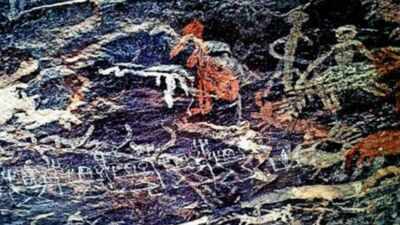
Nilgiris chronicler and anthropologist Reverend Philip Mulley has spent decades documenting the hills, and among the many mysteries of the region, the one that fascinates him the most is that of the prehistoric rock paintings in the forests of Karikaiyur near Kotagiri.The faded red and white figures, he says, remind him of cave art he has seen in Upper Mesolithic sites in France, the Sahara, Australian Aboriginal settlements and Marayur in Kerala’s Munnar hills.“Experts like Dr Allen Zagarell (late), who taught at Western Michigan University, and Dr William Noble, believe the paintings at Karikaiyur are from between 6000 BC and 2000 BC,” says Mulley. “But we need more detailed studies to determine the age accurately.”There are about 11 known sites of rock art in the Kotagiri and Ooty taluks. Among them, the Porivarai (pori meaning letters and varai meaning high rock) rock paintings in Karikaiyur are considered the most significant because they feature the longest stretch of paintings.Located 3,500ft above mean sea level inside dense forests, the site is difficult to access even today.Researchers have documented 662 paintings at the Karikaiyur site. Created using overlapping red and white pigments, the paintings depict scenes of hunting, community dancing, horse and elephant riding, cattle rearing and men fighting wild bulls.In several paintings, gender distinctions can be identified through differences in clothing, hairstyles and body structures. Yet, many of the artworks remain mysterious, with their precise meaning and intent still unclear.
Key highlights
- Around 5,000-year-old rock art: Prehistoric paintings in Karikaiyur near Kotagiri are believed to date between 6000 BC and 2000 BC, though further studies are needed to establish their age.
- 11 known rock art sites: The Kotagiri and Ooty taluks have about 11 known sites featuring prehistoric rock paintings.
- 662 paintings documented: Researchers have recorded 662 paintings at the Karikaiyur site, featuring overlapping red and white pigments.
- Scenes of prehistoric life: The paintings depict hunting, community dancing, horse and elephant riding, cattle rearing and men fighting wild bulls.
- Possible ritualistic significance: Researchers believe the remote locations and imagery suggest that people visited the sites periodically for ritualistic practices rather than permanent habitation.
- Dating remains uncertain: Experts say excavations are needed to establish the paintings’ chronology and understand the ancient cultures of the Nilgiris.
- Conservation concerns: Some paintings have been damaged by visitors scribbling on them. Local restrictions and documentation efforts aim to protect the region’s archaeological heritage.
- Remote locations: The rock art sites are situated in isolated areas, offering clues about how prehistoric communities used the landscape.
- Efforts to protect heritage: Local restrictions and documentation efforts aim to preserve the region’s archaeological heritage for future study.
Why were the paintings made at such heights?
The paintings at all 11 sites are located at heights ranging from 10m to 35m, often on layered rock surfaces. Why prehistoric communities chose such inaccessible heights continues to intrigue researchers.“The paintings appear to be ritualistic,” says R Poonkundran, retired joint director of the Tamil Nadu archaeology department.“The communities selected remote and secure places high in the mountains to protect both the artwork and themselves from predators and harsh weather. But we need excavations to determine the exact dates and understand the mountain civilisation and human activities that occurred during that time, as the Nilgiris is one of the oldest mountains.”Poonkundran says the paintings illustrate various aspects of life in the “mullai thinai” landscape (forest and pastoral regions) described in Sangam literature.“The paintings depict bullfighting, Kuravai dances and herding practices. One large panel shows four figures surrounding a bull and captures 90% of life associated with the region.”He adds that the paintings in red are associated with the Neolithic period, while white paintings could belong to the later Neolithic or early Megalithic phase. The Megalithic period is associated with societies that built large stone monuments and spans roughly from 3000BC to 300CE, though dating varies across regions.
Dating the ancient art remains a challenge
Pointing out that there are challenges in determining the dating of the art without excavation, and that the Nilgiri rock art is struggling to ascertain its period, Poonkundran says, “Currently, the dating is based on approximate assumptions. No Brahmi script (the language of most inscriptions found in Tamil Nadu) has been found in this region.”He also says theories linking the paintings to honey hunting or animal hunting practices are speculative.“There is no evidence yet to prove those theories,” he says.“The earliest known Tamil script dates to around the 6th century BC. Before that, what we see are graffiti-like markings,” says K Rajan, academic and research advisor to the Tamil Nadu archaeology department.Rajan adds that while some symbols may appear visually similar to Harappan signs, they are not linguistically identical.
Rituals, not permanent settlements?
Rajan adds that the paintings do not suggest permanent habitation; rather, they indicate that people visited these sites periodically to paint as part of a ritual.“The sites are deep inside forests, far from settlements, which supports the idea that people visited these places occasionally as part of ritualistic practices,” he says. “Excavation may help us recover samples, establish chronology and understand the ancient culture that existed around these hills.”For local tribal communities, however, the paintings have always been part of the landscape.“We have known about these paintings since childhood,” says K Mani, a member of a tribe. “Earlier, tourists damaged some of the artwork by scribbling over them. Now the area has been cordoned off, and visitors are restricted.”
Documenting the Nilgiris’ archaeological heritage
Meanwhile, Kumaravel Ramasamy and Sudhakar Nalliappan, who work with the Yaakkai Heritage Trust, have been documenting Nilgiri rock paintings, hero stones and tribal monuments.In 2022, they were among the Yaakkai volunteers who spotted more than 200 prehistoric paintings in a collapsed cave in the Bargur Hills, and they have also documented Neolithic stone-tool sites in Tirupur district.Their recent book in Tamil, Neelamalai Tholliyal, documents the hills’ archaeological spaces, including rock paintings, megalithic burials, hero stones, inscriptions, tribal history and rituals, in a single reference volume.They hope it will draw wider attention to the region’s lesser-known archaeological heritage.For Mulley, the paintings are a window into the earliest human way of life.“Some of the figures are of the X-ray type, depicting supernatural mediation and the success of the expedition. No single ethnic group can be credited for the art. Unfortunately, in many places, the art has vanished, tarnished by the mindless acts of visitors in the past. They need to be protected and studied before they are lost.”