









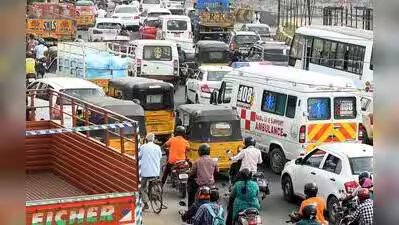
Chennai: Tamil Nadu’s 108 ambulance network has identified 70 road accident “super-hotspots” across the state—busy stretches where crashes occur so frequently during morning and evening rush hours that one ambulance cannot reliably meet demand.The designation has prompted the emergency service to add vehicles or create standby clusters around the most congested locations, including Koyambedu CMBT and near the Maraimalainagar Municipality Office in Chennai. The goal is to prevent one accident call from delaying care for the next.“An ambulance typically takes about 80 minutes to reach a victim, provide first-aid, transport the patient to a hospital and return to service,” said Emergency Management and Research Institute (EMRI) head M Selvakumar. “The problem arises when there are accidents back-to-back in an area, which is what happens at the super-hotspots.With an increase in road accidents and higher demand for ambulances, EMRI managers used the Integrated Road Accident Database (iRAD), a centralised webpage that analyses accident data to identify trends and hotspots after dividing the state into 2x2km grids. They identified more than 450 peak-hour hot spots where most road accidents occurred.At least 70 sites showed the need for more than one ambulance during the peak hours. Among these, the grid near Pollachi bus stop in Coimbatore topped the list with 55 accidents a month, followed by Koyambedu and Maraimalainagar, where more than 40 accidents occurred per month. For instance, one of the grids around Koyambedu junction has remained a hotspot for several months. There are three ambulances, one each at Thirumangalam, CMBT, and Koyambedu metro, within a 2-km radius. “Yet, we can’t move any of these ambulances to that junction because they are hotspots too. So, we added another ambulance at the junction,” Selvakumar said.Ambulances are positioned using an algorithm based on factors such as the number of accidents, available space, and traffic density, officials said. “The problems in each of these hotspots are different and require customised solutions,” he said. One of them is the direction in which the ambulances are positioned. Data showed that in the morning rush hours, there is more traffic and accidents on the national highways on the side where traffic is moving away from the city and in the evening it is on the side where vehicles are moving towards the city. “The ambulance location remains the same, but we just reposition it in the morning and evening to avoid U-turns,” he said.To save time, technicians use software to triage patients, and those with head or neck injuries or severe abdominal bleeding are taken to the nearest hospital under the ‘Innuyir Kappom Nammai Kakkum 48’ scheme.The overall impact is now visible, Selvakumar said. The response time—the time taken by an ambulance to reach the accident site after receiving the call—fell to 11.17 minutes in 2024 compared to 13.46 in 2021. The time it takes for an ambulance to reach hospital has also come down to an average of 18.01 minutes compared to 19.45 minutes in 2023 and 21.50 minutes in 2022.