







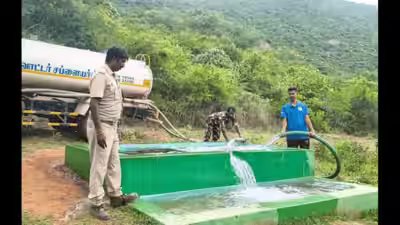
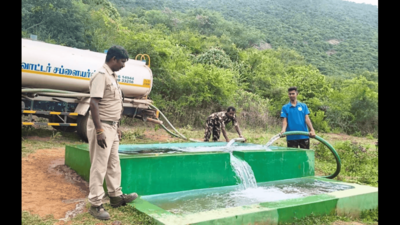
COIMBATORE: Summer routines are continuing for wild animals and forest department personnel in the Coimbatore forest division even months after summer ended. As several water sources remain dried up in reserve forest areas due to a deficit in southwest monsoon rainfall, wild animals continue to travel longer distances in search of drinking water — increasing the risk of their straying into human habitations. At the same time, the forest department has been regularly replenishing 113 artificial water troughs in forest ranges to reduce human-animal conflicts.Officials say streams, ponds and other natural watering points have either dried up or recorded a sharp decline in water levels. The situation is particularly critical in Madukkarai, Periyanaickenpalayam, Sirumugai and Mettupalayam forest ranges.The department is using tractor tankers to fill artificial water sources based on wildlife movement. The initiative is aimed at ensuring water availability for elephants, deer, gaurs and other wild animals inside the forests and preventing them from venturing into villages and agricultural areas.Coimbatore district forest officer N Vengadesh Prabhu says the department usually undertakes large-scale filling of artificial water sources during April and May when summer water scarcity peaks. However, the poor southwest monsoon this year has forced officials to continue the exercise for a longer period. “Usually, we maintain and fill water troughs during the dry months of April and May. But due to the lack of monsoon rainfall this year, we are maintaining 113 troughs in seven ranges in the forest division. Ranges such as Madukkarai, Periyanaickenpalayam, Sirumugai and Mettupalayam are dry. I have instructed all the range officers to continue to artificially fill the troughs to ensure water availability for wildlife,” he says.The department has created a WhatsApp group to collect daily updates on the condition of water sources and wildlife movement. Information is being monitored regularly so that water could be supplied to locations witnessing increased animal movement.The forest areas have also been classified into windward and leeward zones, with additional water sources created in areas identified as more prone to water scarcity. Some troughs are filled with borewell water, while tractors are being used to transport water to some locations.In the Madukkarai range, more than 10 artificial water troughs are being cleaned and filled regularly. Madukkarai forest range officer R Arunkumar says natural streams in the range have dried up because of the lack of rainfall.“Wild animals, including elephants, are visiting the artificial water sources to drink water. Based on animal movement, we decide how frequently each trough should be filled. In some locations, water is supplied twice a week, while in others it is done once a week. Larger troughs are filled once in 10 days,” he says.The Sirumugai range is also facing a severe shortage. The range has 21 artificial water troughs in six beats covering around 11,500 hectares. Bhavani river backwaters, an important natural water source for wildlife in the range, recorded poor water availability this year. “With little water in the Bhavani backwaters, wildlife is facing a water shortage. When animals do not find water inside the forest, they tend to move towards residential areas. Therefore, we are periodically refilling all 21 troughs and monitoring animal movement,” an official says.Forest department officials say maintaining artificial water sources will remain a key measure until rainfall improves and natural water bodies regain adequate levels.