








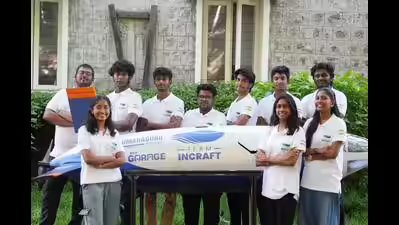
Chennai: An electric racing boat and a human-powered submarine built by student teams from Kumaraguru institutions in Coimbatore are set to represent India at two international maritime engineering competitions in the coming weeks. The teams were in the city this week as part of an outreach programme to meet industry representatives and govt officials, seek support for their projects and explore pathways to scale up some of the technologies they have developed.Team Sea Sakthi will participate in the Monaco Energy Boat Challenge (MEBC) in Monaco from July 8 to 11 with Yali 5.0, a battery-powered racing boat. Team InCraft will compete in the European International Submarine Races (eISR) in the UK from June 29 to July 10 with a single-person human-powered submarine.Developed over 11 months by a 12-member team, Yali 5.0 is operated by a single pilot using a throttle and steering system. Power from the battery is transferred through a controller and motor to a propulsion system, the students said. The boat incorporates a contra-rotating propulsion system designed to recover rotational energy, a phase-change-material-based battery thermal management system and a hemp-fibre composite structure infused with nanocellulose.“This is our fifth time at the competition. This year, we have three innovations in our boat including a focus on the safety of thermal management, the use of contra-rotating propulsion system to increase the boat’s efficiency and the use of hemp-fibre infused with nanocellulose for composite material,” said Vishruti Praveen Kumar, a third-year BBA student and member of Team Sea Sakthi.The boat weighs about 225kg without the pilot and measures 3mX2.5m. The team said it recorded speeds of about 32 knots during testing in a lake in Coimbatore and expects to reach 28-30 knots in Monaco waters. The competition includes endurance, slalom and speed events.Team InCraft’s submarine is powered entirely by a pilot pedalling inside the flooded craft. Built by a 12member team over three months, the submarine uses a chain-driven pedal system connected to a propeller and is designed to operate at depths of four to six metres. The vehicle also features a biomimicry-inspired ‘Swift Bird’ control mechanism for multi-directional manoeuvres and an oyster-shell-based exterior coating intended to prevent marine fungal growth, the team members said.“The race is all about overcoming all the hurdles and slalom and time gates below the water,” said Tanya Vinod Kumar, a first-year BBA student and member of Team InCraft.Students said most subsystems in both the technologies were built by them, while some components were outsourced based on specifications developed by the teams. They are also exploring applications for technologies developed through the projects.The teams are from Kumaraguru College of Technology and Kumaraguru College of Liberal Arts and Science.