







CHENNAI: In the 1970s, when rising petrol prices pushed Tamil Nadu to explore alternatives, engineers at the College of Engineering, Guindy, modified petrol engines to run on 100% ethanol. They tested the technology on city roads, took two cars on a 2,000km journey across the state and demonstrated the results to Prime Minister Indira Gandhi. Yet, concerns over fuel availability and food security prevented the experiment from progressing to large-scale implementation.Now, nearly five decades later, Anna University plans to revive the research as India accelerates its shift towards ethanol-blended petrol. The university will study how ethanol performs at different engine compression ratios, with a focus on flexible-fuel vehicles.The original experiment began in 1973, when petrol prices rose from ₹4 to ₹6 a litre. The Tamil Nadu government asked professors at the Internal Combustion Engine (ICE) Laboratory of the College of Engineering, Guindy (CEG), to investigate alternative fuels that could reduce dependence on petrol.A team led by Professor T R Jagadeesan modified petrol engines to run entirely on ethanol. The changes included replacing the carburettor and altering the ignition, cooling and heating systems.“Ethanol is a good fuel for a petrol engine. It has a high flame speed and burns without producing black smoke,” Jagadeesan said.The main limitation was fuel efficiency. Ethanol produces less energy per litre than petrol, affecting the distance a vehicle can travel on the same volume of fuel.Road tests conducted by the team illustrated the difference. In a 1979 trial, a car returned 7.2km per litre on ethanol, compared with 11.46km per litre on petrol. On highways, the corresponding figures were 9.38km per litre and 14.9km per litre.An Ambassador car supplied to the researchers recorded a mileage of 6.2km per litre on ethanol, against 9.54km per litre on petrol, during a city-road test on January 21, 1980.The researchers, however, found that engine modifications could improve ethanol’s performance. They increased the compression ratio of a Fiat car engine from 7:1 to 11:1 and modified its carburettor and other components. At the original compression ratio, the ethanol-powered engine recorded a thermal efficiency of 26%, compared with 25% for petrol. With the higher compression ratio, the efficiency rose to 32%.
From Chennai to Ooty on ethanol
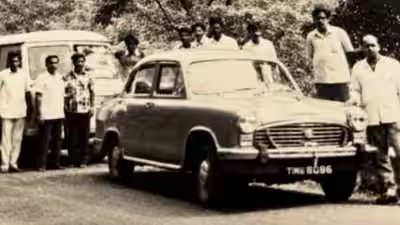
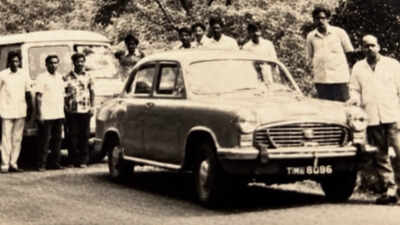
The team went beyond laboratory experiments to test the technology under road conditions. Two cars undertook a 2,000km journey from Chennai to Ooty, then to Kanyakumari and back to Chennai. The vehicles negotiated hill roads, and the engines could be restarted in Ooty without difficulty.The work attracted the attention of then chief minister M G Ramachandran, who wanted Ambassador cars at the state secretariat to run on ethanol. Vehicles used by senior officials were subsequently operated on the fuel and brought to the Anna University laboratory for refuelling.The technology was also demonstrated to Indira Gandhi and then finance minister R Venkataraman. Despite the interest generated by the trials, the project did not receive approval for large-scale implementation.“Perhaps we were ahead of our time,” Jagadeesan said.The central challenge was not whether an engine could run on ethanol, but whether enough fuel could be produced without creating other problems. At the time, ethanol production was closely linked to sugarcane. Diverting agricultural produce towards fuel raised concerns about food security, with policymakers wary of a programme that could compete with food consumption.The team also explored the use of ethanol in diesel engines. It tested the fuel in diesel engines used by farmers and in a bus engine supplied by Ashok Leyland. The researchers achieved an 80% ethanol blend in a diesel motor pump set and a 40% blend in the bus. Since ethanol and diesel do not mix easily, the fuels were supplied separately.Conducted between 1975 and 1985, the research was presented at international forums in the UK, the US, Canada and Brazil.“We proved five decades ago that 100% ethanol could be used in modified petrol engines. Even after five years of testing, the engines showed no damage. The wear and tear was similar to what happens when petrol is used,” Jagadeesan said.
Why the research is relevant again
The circumstances surrounding ethanol have changed since the original experiments. India imports more than 80% of the crude oil it consumes, making alternative domestic fuels an important part of its energy strategy.The country’s ethanol-blended petrol programme seeks to reduce dependence on imported crude oil, support farmers and promote domestically produced renewable fuel. Ethanol blending rose from less than 1.5% in 2013-14 to 20% in 2025-26, reaching the target five years ahead of schedule.Under the E20 programme, petrol is blended with 20% ethanol and 80% gasoline. The rollout has also triggered concerns over reduced mileage and the possible impact of higher ethanol concentrations on engine components not designed for such fuels.Anna University believes advances in ethanol production could help address some of the constraints that held back the earlier research. Ethanol can now be produced from multiple sources, including agricultural residues, potentially reducing the pressure on food crops.“The case for ethanol as an alternative transport fuel has strengthened. Ethanol can now be produced from several sources, including agricultural residues, potentially reducing the pressure on food crops,” said V Kumaresan, registrar-in-charge of Anna University.The university will also participate in an ethanol research project involving IIT Madras and universities in China and Brazil. The Tamil Nadu government has allotted a research grant of ₹5 lakh to the team.The revival comes as India weighs the benefits of ethanol against its limitations. Blending can help reduce crude oil imports, save foreign exchange and provide a market for agricultural produce. But ethanol’s lower energy content can affect mileage, while the use of water-intensive crops such as sugarcane and rice raises questions about water availability and the food-versus-fuel trade-off.For the researchers at Guindy, the question five decades ago was whether petrol engines could run on pure ethanol. They demonstrated that they could. The next phase of research will examine how that early work can be adapted to today’s vehicles, fuel supply chains and energy priorities.