








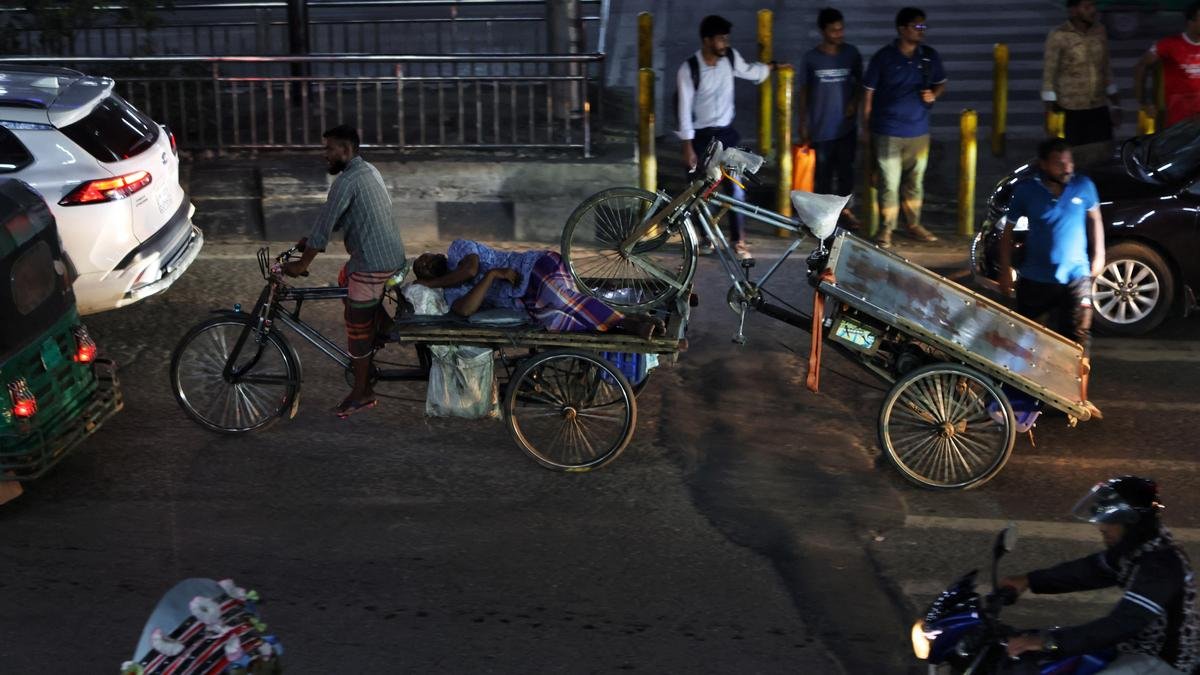
Hours-long power cut and sweltering heat are disrupting daily life across Bangladesh, exposing the six-month-old BNP government to mounting public anger and opposition criticism as officials concede the crisis could persist for at least another week.
Abdur Rahman (32), a resident from Kamalnagar, a rural upazila in the southern district of Lakshmipur, said the power cuts had become so relentless that residents could no longer plan their day around them. “It doesn’t matter if it’s morning, noon or night, the electricity simply won’t stay. We’re lucky if it lasts an hour before vanishing for the next ten,” he told The Hindu. The blackouts, he said, showed little mercy even after dark, cutting out in the middle of the night without warning and staying off for hours.
The crisis is not confined to the countryside. Bijoy Talukdar, who works for a private firm in Dhaka and lives in the capital’s Moghbazar area, said he had assumed the outages afflicting his relatives in rural areas would spare the city. “The power was gone for three to four hours on Thursday, right in the heart of the city. It cut out four times today alone,” he said
Supply crunch driven by gas shortage
The immediate trigger appears to be a severe shortfall in natural gas supply, which has left several gas-fired power plants unable to run at full capacity even as electricity demand climbs with the heat.
According to officials, the country’s total gas supply fell to around 2,100 million cubic feet per day (mmcfd) against a demand of roughly 3,800 mmcfd. Domestic gas fields contributed about 1,630 mmcfd, while two floating LNG terminals supplied up to 410 mmcfd — the lowest combined supply since a July 21 fire disabled the U.S.-owned Excelerate Energy terminal.
That terminal partially resumed operations on August 5, but a second, Summit-operated terminal began cutting supply from August 10 after it was unable to unload LNG from incoming tankers, citing bad weather and technical problems. Coal shortages have also kept several major power plants from running at full capacity, while electricity imports from India have declined, compounding the shortfall.
The shortage was particularly acute between August 11 and 12. Load-shedding peaked at 3,592 MW at midnight on August 11, when a demand of 17,523 MW outstripped supply of 13,931 MW. Demand peaked again at 18,043 MW at 9 p.m., against supply of 15,036 MW- a deficit of over 3,000 MW that persisted past 1 a.m. and 2 a.m. the next day.
Though conditions eased somewhat the following morning, load-shedding climbed again to 2,688 MW by noon and 3,382 MW by 3 p.m. on August 12. National grid load-shedding is now regularly exceeding 3,000 MW a day, with rural areas bearing the brunt: some are receiving as little as five to seven hours of electricity a day, while others go without power for 17 to 20 hours at a stretch. To ease the burden on villages, load-shedding has now begun in cities, including Dhaka.
Falling gas pressure has also pushed households onto electric stoves, adding further strain to the grid. At the same time, industries reliant on their own gas-fired generation have been forced to switch to grid power as well, compounding demand alongside heavier use of fans and air-conditioners in the heat. Amid all this, the Summit-operated terminal’s supply of LNG was halted on Thursday (August 13, 2026) afternoon due to bad weather, further reducing the country’s already strained gas supply.
Government orders early closures, anger boils over
In response, the Power Division on Wednesday (August 12) ordered shopping malls, markets and shops nationwide to shut by 8 p.m., an hour earlier than the previous 9 p.m. cutoff, effective from August 12. All illuminated billboards must now be switched off by 7 p.m., and decorative lighting has been banned entirely.
Public frustration over the outages has already turned violent in places, with electricity offices in several areas facing attacks, vandalism and staff being confined by angry residents. Public anger over the relentless power and gas crisis has repeatedly spilled onto the streets in recent days.
CNG-run auto-rickshaw drivers blockaded the Dhaka-Sylhet highway after filling stations ran dry, while residents in several districts stormed electricity offices, smashing property and confining staff inside in protest at outages stretching to 15-20 hours a day.
Reports from Gopalganj, Netrokona, Rangpur, and Kishoreganj indicated violent protests by residents at substations and discom offices. To pre-empt further unrest, the Bangladesh Rural Electrification Association has written to the Inspector General of Police seeking security for their offices, substations and other key installations.
Opposition accuses government of “irresponsibility”
The crisis has become a political flashpoint as well.
Jamaat-e-Islami, the main Opposition party, accused the BNP-led government of failing to take “effective” steps to resolve the crisis, calling it a sign of the administration’s “irresponsibility” towards the public. In a statement on Thursday (August 13) evening, Jamaat secretary-general Mia Golam Parwar said gas supply on Wednesday (August 12) had stood at just 2.03 billion cubic feet against demand of 3.8 billion cubic feet, and blamed the crisis on government’s “mismanagement, inefficiency, lack of foresight, corruption in various institutions and politicisation.” Mr. Parwar also flagged the absence of long-term planning in power-sector management.
The National Citizen Party (NCP) also weighed in, with its convenor and Chief Whip of the Opposition, Nahid Islam, saying the current power and energy crisis stemmed from a lack of planning and indecision in energy procurement. Mr. Islam alleged that although the BNP had come to power promising a government of the people, what was actually taking shape was a “government of oligarchs.”
Minister says “no alternative” but to wait
Power, Energy and Mineral Resources Minister Iqbal Hassan Mahmood acknowledged the crisis , saying repairs to the floating storage and regasification unit (FSRU) disabled in the July fire had to be completed before supply could improve.
“This is all I can say: we are working… there is nothing I can do right now, because I cannot increase gas production, and without the FSRU, I cannot unload the gas that we have,” he said, adding that peak electricity demand was shifting to midnight as consumption pressures mounted, with total demand now touching around 18,000 MW.
Bangladesh seeks India’s help
Facing no immediate fix to the crisis, Bangladesh has turned to India for relief, with Power, Energy and Mineral Resources Minister confirming that Dhaka had asked New Delhi to supply more diesel through the existing cross-border pipeline.
The request came up during what the Minister described as a routine meeting last week with the Indian High Commissioner on matters of mutual interest between the two neighbours, though he did not elaborate on whether India had responded, or on any parallel request to boost electricity imports that have already declined amid the shortfall.