









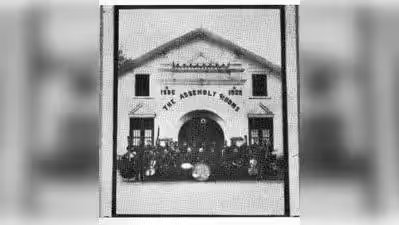
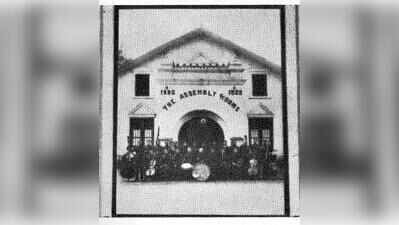
Shantha ThiagarajanIn 1922, Lord and Lady Willington bought Ooty’s ‘Assembly Rooms’ and placed it in a trust for the public, a gesture meant to keep the space open to the town, not to any private owner. But now, more than a century later, a proposal by the trustees to lease the 140-year-old public cinema hall to a private player and convert it into a commercial duplex-screen complex is worrying conservationists. The trustees also want to develop the theatre’s backyard into an additional theatrical space, deepening concerns that this is less a renovation than a reinvention. The proposal has reopened a question of who really owns Ooty’s heritage, and who has the right to lease it out.Built in 1886 as a British social and ballroom space, the Assembly Rooms, the only space of its kind in south India, is run as a non-commercial public trust managed under the Nilgiris district administration. A public charitable trust established in 1923 manages the Assembly Rooms, with the Tamil Nadu governor as its ex-officio patron and the Nilgiris district collector as its ex-officio president. The heritage building falls under the Tamil Nadu Heritage Commission Act, 2012.This isn’t the first time the public has pushed back on plans for the Rooms. The State Bank of India withdrew its attempt to install an ATM on the premises after public outcry. Last year, plans for a police help desk on site were stopped after objections from residents. For nearly five years, from 2011 to 2015, Assembly Rooms was closed for maintenance costing `24 lakh. No board of trustees was elected for the trust during this period.“Over the years, the Assembly Rooms have been protected by the govt, management and the public. Any changes to its structure, function, or maintenance must comply with the Tamil Nadu Heritage Commission Act of 2012, which protects structures of heritage value that are over 100 years old,” says Venugopal Dharmalingam, director of the Nilgiri Documentation Centre (NDC), which was the first to respond to the issue when a notice of the petition seeking permission for leasing was displayed in the Assembly Rooms. “It is a theft of Ooty’s heritage,” says Venugopal.Lawyer B J Krishnan, an Assembly Rooms trustee in the 1980s, says, “The proposed lease is a fig leaf, trying to cover up privatisation of a prime public land situated right in the heart of Ooty town.” According to D Radhakrishnan, honorary secretary of Assembly Rooms, the lease period will depend on the viability of the private party involved.Krishnan says the Assembly Rooms is more than just a “cinema hall”. “It should be developed and used as a centre for performing arts, musical performance, cultural activities and should be open and available for the public. The Rooms should not be gifted away to private parties.”Ramakrishnan Nambiar, a trustee, says procedures are being legally followed. “That is why we sought court approval as per protocol.” The main issue, says Ramakrishnan, is a lack of resources. “Income from car parking is not enough for upkeep. Locals are travelling to the plains for a better cinema experience. We are planning to upgrade Assembly Rooms to be on a par with cinema complexes in the plains.” Legal experts say that, as a public and charitable trust, trustees do not have the authority to select a specific private individual or entity to lease the premises. The government has established norms and protocols, and the Assembly Rooms is obligated to follow them. This leasing proposal lacks transparency, and Assembly Rooms should not operate like a secret society.“The Assembly Rooms must be regarded as a form of a social service, and it was with this object that Assembly Rooms was opened,” says Venugopal. The public charitable trust was created in 1923 to celebrate the centenary of the founding of the country’s first hill station, Udhagamandlam (Ooty), and to provide public entertainment and recreation. The public raised `50,000 through contributions. “A public charity cannot be converted to a private enterprise without valid reasons of public interest.”A Edwin, a resident and regular visitor to the Assembly Rooms, says people go there for the experience, not the cinema. “With its heritage set-up, watching a movie in the Assembly Rooms is a different experience,” he says.In a public clarification, the board of trustees says it will “communicate all material details to the public at the appropriate stage, once proposals are formalised and the necessary approvals are pursued”.Lakshmi Bhavya Tanneeru, Nilgiris collector and ex officio president of the Assembly Rooms Trust, says the “matter relating to the proposed arrangement is before the competent court for permission”. “The Trust is following the legal process applicable to the proposal,” says Lakshmi.FACE OFF: Legal or not?D Radhakrishnan, Honorary secretary of Assembly Rooms | Aim is to upgrade the technology and infrastructure, as the present system is outdated, and install duplex screens without disturbing the building’s heritage.B J Krishnan, Lawyer and former trustee | Leasing it out is not the solution. Trust should have approached the Tamil Nadu govt for guidance and resources. The govt would have come forward to protect, preserve and upgrade this heritage institution.Radhakrishnan | Previous governor R N Ravi approved the development of Assembly Rooms, which allows amendments to the trust deed. The next step is to have it confirmed by court.Krishnan | Governor is only ex officio patron. Under trust deed, governor does not have the authority to amend the deed to permit the leasing of the premises. A lease is a transfer as defined under the Transfer of Property Act. Its duration cannot be open-ended; it must be clear and definite. Since Assembly Rooms is a public charitable trust, Ooty residents have the right to know the lease terms and conditions.Radhakrishnan | Assembly Rooms is not subject to govt regulations, so we can select an architect and builder without a tender process. The board is supreme and has the ultimate authority to make the final decision, which cannot be contested.Krishnan | If Assembly Rooms, a public charitable trust, is leased out to private parties, the board will become infructuous and redundant.Preservation of its historical and architectural character is paramount. The objective of bringing in professional investment and management is to ensure that the building can be properly restored, maintained and made financially sustainable in the long term — Lakshmi Bhavya Tanneeru | nilgiris collector and ex officio president of trust