








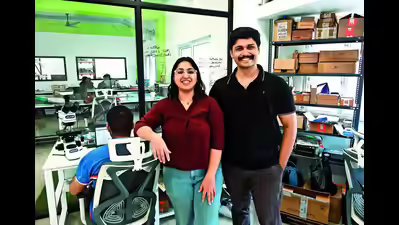
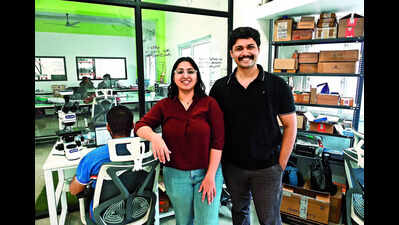
Iron-air is now emerging as a leading technology for long-duration energy storage (LDES), driven by compelling unit economics and storage chemistry. One startup has taken an ambitious approach to building the battery tech from the ground up.Founded in 2022, Meine Electric is building a utility-scale battery energy storage system designed for 16- to 24-hour cycles. Its iron-air batteries exploit a property generally seen as a flaw – rusting. “During discharge, metallic iron anodes react with atmospheric oxygen to form rust, releasing energy and the process is reversed during charging,” says Priyansh Mohan, co-founder and CEO of the company. Offering a breakdown of the iron electrodes at the heart of its battery technology, Priyansh says the idea was to make iron oxidise into a stable, microscopic structure that stays anchored to the electrode instead of flaking away and losing capacity.These batteries are cheaper than lithium-ion and are suited for storing intermittent wind and solar power. The startup has built proprietary technologies across material science and engineering, including readily available technologies such as membranes and equipment to make them reliable and economically viable at scale. “For the first two years, we worked on this artificial lung membrane,” Mohan noted. This hydrophobic barrier breathes in oxygen while keeping the internal liquid trapped. By making the membrane’s active electrocatalyst in-house, the startup slashed its cost from roughly `2,400 a gram in the open market to just `33.Mohan’s fascination with batteries began during his mechanical engineering studies at the College of Engineering, Guindy (Anna University), where sourcing materials for research projects exposed him to commercial supply chain realities. He later reconnected with his schoolmate, Stuti Kakkar, who was focusing on energy economics. After evaluating various chemistries, they selected iron-air for its low cost, long discharge duration, and highly domestic supply chain. This gains significance today, as recent Chinese export curbs on critical minerals and battery manufacturing equipment underscore India’s vulnerability in the lithium-ion supply chain, battery tech and know-how.Meine Electric has already secured two kilowatt-scale pilot orders with major private and public sector (PSU) power producers. It is also drawing interest from energy-intensive commercial and industrial (C&I) consumers, such as data centres, looking to slash their average electricity bills.While globally, iron-air batteries have slow charging optimised for 100-hour grid back-up, the startup positions itself as the operational asset to increase utilisation of solar and wind assets, as India grapples with renewable power curtailment. The electricity prices falling to zero in the Indian energy exchange for the first time in May show how acute the issue is. The startup has developed a six-hour fast-charging system to tap peak solar hours and discharge every night through a capex model.Iron-air batteries have lower round-trip efficiency (RTE), which essentially means it’s returning only 55–60% of the energy put into them, compared to 85–95% for lithium-ion. However, the startup targets 2-3 times lower deployment cost compared to lithium due to a massive reduction in capex. Deployment costs are projected at under $40 per kilowatt-hour (around `3,500), two to three times cheaper than the $110–$120/kWh required for lithium-ion, noted Kakkar, co-founder & COO. Because the battery is built from abundant iron, water, and air, this manufacturing cost easily absorbs the efficiency losses. “When paired with affordable renewable energy, we expect to achieve a levelized cost of storage (LCOS) of approximately `3 to `5 per kWh for 16-to-24-hour storage,” she said.