









Lying at the foothills of the Mao mountains in southern China, the Temple of King Ashoka is one of the main attractions in Ningbo, a port city in southern Zhejiang Province, around 200 km south of Shanghai. Hymns fill the courtyards of the massive temple complex, which is largely empty on a busy weekday.
The temple’s history goes back more than 1,700 years, when it was built during the Western Jin Dynasty. It is one of the 19 Ashoka stupas constructed in China as Buddhism spread. In Ningbo, Buddhist culture, coupled with a long tradition of maritime commerce, has been an important part of the city’s history since the 7th-century Tang Dynasty, when it emerged as a major port.
Also Read: How is China leading the green energy sector?
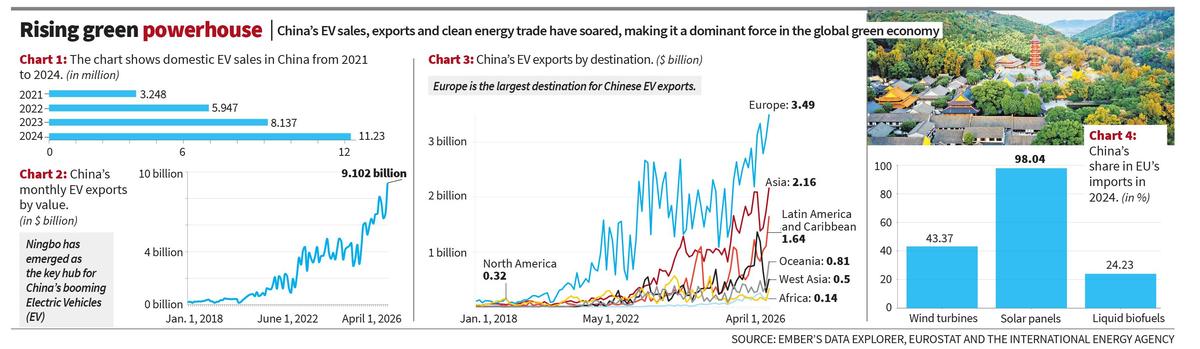
Today, the city has emerged at the heart of a different kind of global commerce. It is a key hub for China’s booming Electric Vehicles (EV) industry, where new energy automotives are manufactured in sprawling, modern factories and then exported around the world.
‘A future factory’
“The future is our history,” reads the sign above the entrance to the factory of Zeekr, a high-end EV brand headquartered in Ningbo and part of the Chinese automaker, the Geely Auto Group. Geely also manufactures Volvo Cars, having acquired the company from Ford in 2010, and luxury Lotus autos, after garnering a controlling stake in the British automaker in 2017. EVs have become central to Geely’s future. The group sold close to 1.7 million EVs in 2025, a stunning 90% rise from the previous year.
In China, Zeekr is the group’s flagship product in this space. Zeekr’s cars that roll off the assembly line in Ningbo are transported across China and shipped to Europe and Southeast Asia, its two biggest overseas markets. The Ningbo plant, company representative Zhang Ting said, has been dubbed “a future factory”.

It is not hard to see why. The factory floor is a scene out of Star Wars. Automated yellow robotic transports that look like toy cars whizz around the factory floor. One beeps in protest as it brushes up against my feet. Frames of yet-to-be-completed EV cars descend from massive yellow platforms onto the assembly line, where the only humans on site are inspectors checking them for flaws. “Around 60-70% of the work is done by robots,” Zhang said. There are still some 2,300 people working in this factory, where the EVs are assembled into their final form. The welding factory, also in Zhejiang, is completely autonomous.
A dashboard notes that as of 4 p.m. on a recent afternoon, 366 cars had rolled off the production line, somewhat below the maximum daily capacity of 1,300. The reason, one Zeekr executive explains, is an intended nimbleness. The quick turnaround time allows the company to follow a model where it only manufactures cars for which it has already received a confirmed order.
Zeekr’s “future factory” was the result of a 10 billion RMB ($1.47 billion) investment. At every turn, the emphasis is on “green”. One live dashboard measures the factory’s carbon footprint at any given minute, including the electricity and water use per vehicle, and the savings from a waste heat recovery system designed to be energy-efficient. This year, the savings have so far amounted to the equivalent of the annual gas consumption of 736 Chinese households.
On top of the ‘green charts’
Going green appears to have become an obsession in Zhejiang, a province in China’s southern manufacturing heartland that played a key role in the country’s reform and opening-up period starting in the 1980s.
Wang Hao, an official from the provincial government, reels off statistics showing the Province at the top of China’s ‘green charts’. Zhejiang’s PM 2.5 particulate air pollution fell last year to an average slightly under 25 — “like Europe,” another official said. Last year, the Province notched two other landmarks: renewables, for the first time, accounted for 50% of total installed energy capacity; and 100% of the surface water met national standards, following a massive campaign to crack down on industrial waste.
Also Read: Will China capture the electrolyser market? | Explained
Across the city from the sleek Zeekr factory is a symbol of Ningbo’s past — the towering smoke stacks of the Ningbo Iron and Steel Company, or Ninggang, one of China’s oldest and biggest steel producers. Local officials cite the company’s story as a snapshot of China’s green transition — and how Beijing spent billions in overhauling older polluting industries and holding them to stricter emission standards.
At Ninggang, around 4 billion RMB ($588 million) was spent on “more than 100 emission renovation projects,” Yang Zhenzhu, a representative of the company, said. Many of these were aimed at reducing emissions and more efficiently recycling the wastewater from steel production. Today, the company hosts visitors from companies around China, who come to study it as a model of change.
The first stop on the Ninggang tour for visitors, who are separated from burning hot furnaces carrying golden, molten iron by thin glass walls, is an elaborate water treatment arrangement. All of the water that is used is recycled, coming from the city’s major wastewater treatment plant. This water is piped to Ninggang’s own treatment station for further treatment, and the excess is desalinated and reused. Zero solid waste is allowed to leave the factory. Waste containing iron and carbon is treated at another treatment facility and reused.
Pollution remains a serious problem in China. Even in Beijing, despite the undeniable progress — “airpocalypse” days that were regular in the winters of Beijing a decade ago are now far less common — maintaining clean skies is a continuing battle. One clear takeaway from Zhejiang is that the green transition neither came easily nor for free. Indeed, it required serious and sustained investment on the one hand, and no-nonsense policing and enforcement on the other.
Corruption is rarely spoken of in the context of pollution. Yet, Chinese officials often point to how, in the past, lax enforcement was a huge challenge. Bribes to local officials to look the other way were a common phenomenon. But a crackdown on corruption over the past decade has changed that. It is much harder for polluting factories to pay their way out of punishments for violating standards, while “big data” is being deployed to track factories in real time.
If investment and enforcement have been two key pillars of China’s green transformation, technology is a third. Chinese companies making EVs, batteries, and solar panels are in an apparent unending race to come up with technologies that are more efficient and cheaper. Technology, more than cost, explains China’s dominance of the global EV market, He Xiaopeng, who is the founder of another Chinese EV player, Xpeng Motors, a competitor of Zeekr’s, said. “Meaningful competition lies in capabilities, technology and systems. It is not only about price,” he said.
China accounted for around 60% of all global EV sales, according to the International Energy Agency’s (IEA) Global EV Outlook 2024. Its dominance in batteries is starker, with China controlling 76% of global lithium-ion battery cell manufacturing, giving its firms a major cost advantage, according to Bloomberg data. Solar photovoltaics are a similar story. To give a sense of the scale, China in 2023 commissioned as many PVs as the rest of the world did, according to the IEA. China’s overwhelming presence in the critical minerals industry underpins its dominance of supply chains, with the country processing 90% of rare earth elements, and 60-70% of lithium and cobalt, which are key for manufacturing batteries.
Indeed, China’s proposition to the world is “a complete supply chain”, Qian Zhimin, who is Deputy Director of China’s Committee on Population, Resources and Environment, said.
For Chinese policymakers, the ongoing crisis in West Asia has only further driven home the urgency of green transformation and the advantages of diversifying energy sources. “Today, energy security and green transition are converging,” Qian said. “The recent tensions [in West Asia], and the tensions we are seeing in maritime routes like the Strait of Hormuz, mean traditional energy systems continue to face strong external shocks. So, the green transition is now a practical choice to enhance energy security and self-reliance in a complex external environment. And China offers a complete supply chain,” he said.
Impact on the world
If China sees its “complete” supply chain as a strategic advantage, for the rest of the world, dependence on China in these industries of the future is a cause for concern. China’s cost competitiveness and technological edge may be enablers of green transformations, but the other side of the equation is the enormous impact of Chinese imports on companies in these sectors around the world that are struggling to stay afloat. The European Union (EU) is a case in point.
The EU, along with Southeast Asia, has more than any other region opened up to Chinese EV and renewable energy companies. China’s exports, warned a February 2026 report from an advisory body to the French government, were “affecting the core of Europe’s industrial strongholds: automotive, batteries, industrial equipment, chemicals, and others.”
“On average, nearly a quarter of European exports is currently exposed to Chinese competition that we deem critical,” it said. “On the domestic market, up to 55% of European manufacturing output could be threatened over the medium term if current trends persist. This proportion varies significantly across countries: it reaches around 70% in Germany, 60% in Italy, 50% in Spain and 36% in France,” the report added, noting that in 2024, the EU imported €11.1 billion worth of solar panels, €2.9 billion of liquid biofuels, and €0.5 billion worth of wind turbines from extra-EU countries, totalling about €14.5 billion in imports of green energy products. China accounted for 98% of these imports.

Fearing the prospect of “accelerated deindustrialisation”, the report said the cost gap estimated by European companies with regard to China was 30-40%. It cited PVs as an early indicator of what may come in other sectors. Since the mid-2000s, when China began massive investments in solar, its growth has led to “a near-monopoly situation for China in photovoltaics” with market share “exceeding 80% across all segments of the value chain.”
Leadership on climate change
For much of the Global South, however, China is seen as offering the prospect of an affordable green transformation — a proposition that, many countries note, the West has been unable to compete with, even as the U.S. withdraws from global leadership on climate change.
“China is a leader in this area not for no reason,” Fazeel Najeeb, who is the Maldives Ambassador in Beijing, said. He was recently in Ningbo along with the country’s Minister of State for Climate Change, Environment and Energy, Mohamed Faiz, at a Shanghai Cooperation Organisation green forum convened by China, reflecting its global ambitions in the sector. “China’s leadership is undeniable, whether or not others are withdrawing from issues such as climate change that have a huge bearing on countries like us.”
The Maldives, for instance, is clear about seeking opportunities from China, including for its landmark RasMale project, an initiative pushed by President Mohamed Muizzu, which envisages building a zero-carbon safe island on 1,153 hectares of reclaimed land.
“We are requesting China to work with us to make this island a future city powered by renewable energy entirely, with electric cars and no fossil fuels. Right now, we spend around 33% of our GDP on fossil fuels. We would like to change this,” Najeeb said
The Maldives is among the many countries in the midst of energy shortages. The Iran crisis, Qian notes, has driven home the lesson that renewable energy “reduces vulnerability to fluctuations in international oil price and enhances economic resilience.” He points out that coal still accounts for 52% of primary energy consumption in China and 56% in India. “The fact is that energy security and green transition are not a binary choice for us,” he said, “but a strategic pathway on which both complement each other.”