


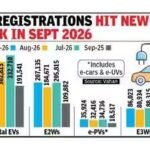






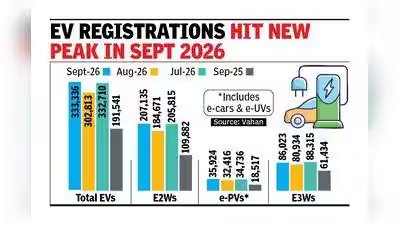
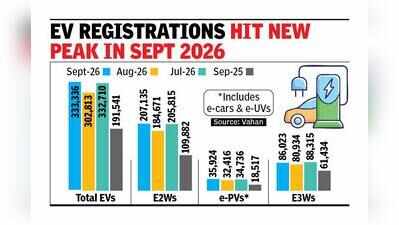
Chennai: September turned out to be a record month for electric vehicles, with total registrations across segments touching an all-time high of 3.3 lakh units. The final number is likely to be slightly higher as there is typically a time lag before all registrations are reflected on the Vahan dashboard.Last month was also the fourth consecutive month in which EV registrations crossed the 3-lakh mark, signalling sustained momentum for battery-powered vehicles in the country.The sales surge in Sept was broad-based, with both electric two-wheelers (E2Ws) and passenger vehicles posting new monthly records. E2Ws led the charge, with registrations climbing to a record 2.07 lakh units, registering significant year-on-year growth.TVS Motor more than doubled its volumes year-on-year to about 54,000 units, as its monthly volumes bounced back to above the 50,000 mark after falling below that level in August. Bajaj also more than doubled its volumes year-on-year to about 48,400 units, while Ather’s volumes stood at about 30,500 units, compared with 19,620 units in September 2025. Hero, Ola and Greaves sold more than 24,300 units, 13,450 units and 9,300 units, respectively.Electric passenger vehicles (e-PVs), too, hit a new high of around 36,000 units, almost double the volume sold in Sept 2025, indicating that electric cars are steadily gaining traction despite their relatively higher upfront costs.Tata remained the leader with e-PV sales of about 14,712 units (7340 units in Sep’25). Mahindra occupied the No. 2 spot with sales of 7,742 units (3783 units) and widened its gap with the third-ranked JSW MG Motor, which sold 5,226 units in Sept this year (4800 units). VinFast sold 2,960 units (just 6 units in Sep’25).Electric three-wheeler sales also bounced back in Sept to more than 86,000 units, compared with around 80,000 units in August and 88,315 units in July. In Sept 2025, sales stood at 61,434 units.The sustained sales rate above the 3-lakh-unit threshold suggests that EVs are moving into a higher-volume trajectory, supported by a wider choice of models, improving charging infrastructure, and growing consumer confidence in electric mobility.