









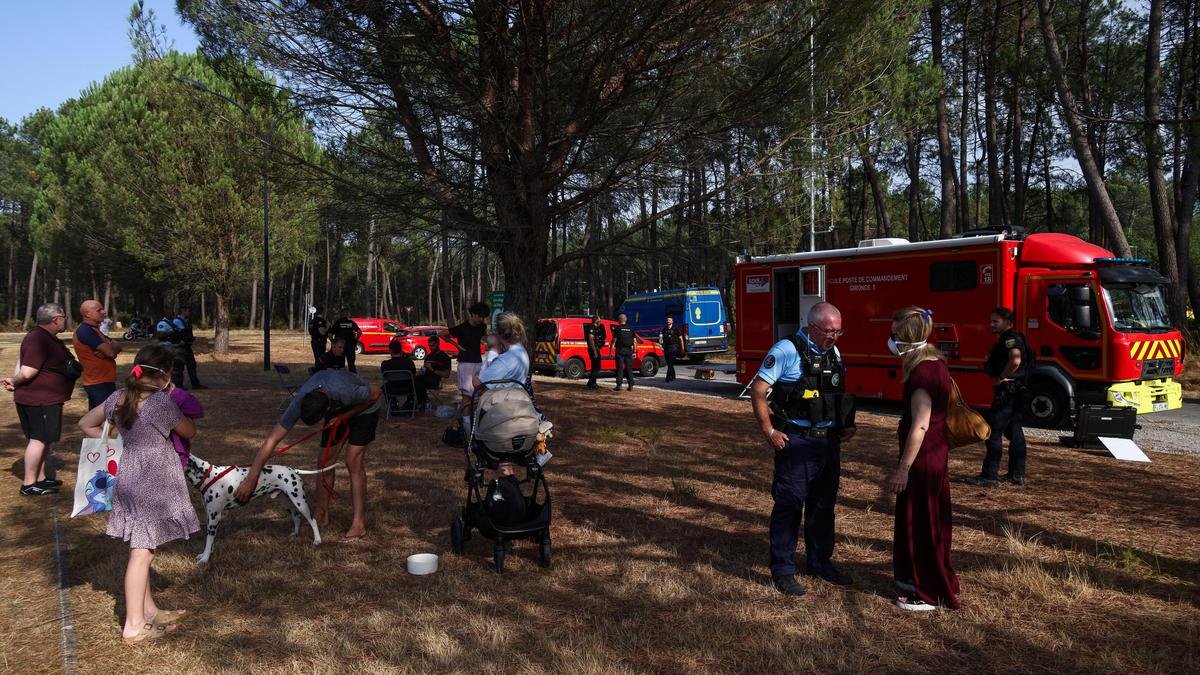
Much of Europe is bracing for yet another scorching heatwave following periods of record drought that have driven rivers to historic lows, ignited historic forest fires and contributed to thousands of deaths.
Swathes of Britain and France on Monday (August 10, 2026) were already under extreme heat warnings with forecasts of temperatures around the mid-30s C, while parched conditions saw new fires erupt in Greece and Spain.
Unusually high temperatures were also forecast in the coming days across a number of countries not accustomed to the heat, such as Switzerland, Austria and Hungary.
The heatwave comes after mainland France and Switzerland saw their widest-ranging droughts for July on record, according to an AFP of data released by Europe’s Copernicus climate observatory on Monday (August 10).
Europe’s weather warning system, MeteoAlarm, on Monday (August 10) also said scorching temperatures are already being felt across much of Italy and coastal areas of Croatia.
Here’s what to know as temperatures soar again across the continent, the fastest-warming on the planet due to human-caused climate change.
‘Intense heat’
The United Kingdom’s Met Office warned at the weekend that the summer’s fifth hot spell was about to take hold in a country whose infrastructure was built for a more temperate, cooler climate.
Nearly three-quarters of England and the whole of Wales is already officially in drought, with more than 27 million people under water-use restrictions, and with the environment department warning on Monday that “all regions of the country are experiencing pressure on their water resources”.
Next to no rain was forecast for the affected areas this week.
In France, the national weather agency Meteo-France warned on Monday (August 10) that the southeast would see temperatures as high as 35C, spreading further across the country as the week progresses.
The agency also warned that due to climate change, “future summers will generally be hotter than those experienced to date”.
The environment ministry said on Monday (August 10) that “nearly 70% of French territory is subject to restrictions on water use”, with the liquid reserved for priority uses such as healthcare, sanitation and drinking water in the areas most at risk.
Both France and the U.K. have seen thousands of excess deaths during previous heatwaves this year.
Fires and drought
Greece reported its second fire this season near the capital Athens on Monday (August 10), despatching hundreds of crew and equipment.
Already, more than 10,000 hectares (24,700 acres) of pine forests were blackened by a blaze that broke out 10 days ago northwest of the capital.
Firefighters were also struggling to contain a rapidly expanding blaze in southwestern Spain that had forced the evacuation of some 800 people and counting.
The weather was offering “no respite”, local officials said.
France and Spain have already seen historic wildfires so far this summer, with record levels of drought causing tinder-dry conditions.
Some 95% of mainland France and 99% of Switzerland saw drought conditions in July, both record figures since the European Drought Observatory began collecting such data in 2012, according to an AFP analysis on Monday (August 10).
Heat and drought are also driving rivers across Europe to record lows. The Rhine in Germany could drop so much it becomes unnavigable, industry groups warned on Monday (August 10).
And Polish officials announced that the Vistula, the country’s longest river, had matched its record low in Warsaw on Monday — a record set only on Friday.
Low levels along the Danube River have already seen Hungary and Romania forced to consider shuttering their nuclear plants, which rely on the water for cooling, in late July — though both managed to avoid doing so for now.
By the numbers –
Nearly 120 million Europeans live in regions where July 2026 was the hottest ever recorded, according to an AFP analysis of national weather agencies and Copernicus climate data.
The records were concentrated in southern Britain, western France, and northern and eastern Spain.
At least 12,000 excess deaths were recorded across nine European countries during one heatwave in June, an AFP analysis of national statistics found last month, a toll that could rise as more data is released.
Solar eclipse
A solar eclipse that will be visible across parts of the European continent on Wednesday (August 12) is expected to attract skygazers despite the unwelcoming weather.
The European Space Agency’s observatory in Teruel, Spain, will host a day of activities up to the main event with the eclipse beginning at 7:33 p.m. and reaching totality at 8:23 p.m..
The area saw temperatures breach 30C on Monday and the eclipse will cross over areas that were hit by the devastating Spanish fires last month.
Published – August 10, 2026 10:55 pm IST


