








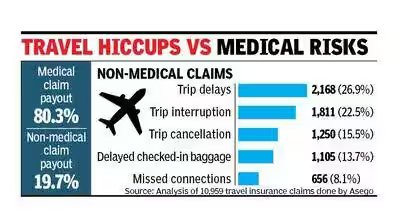
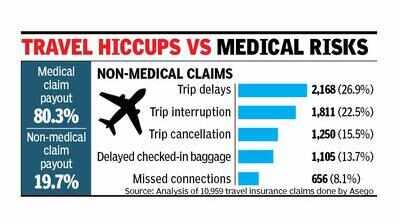
Chennai: The year-end holiday season is in full bloom. A report, exclusively shared with TOI by a global travel assistance and insurance provider, reveals that between April 2026 to Nov 2026, non-medical claims such as trip delays and cancellations, baggage delays, and missed connections have higher number of claims (73.5%) compared to medical claims (26.5%). However, the Asego report says that medical claims accounted for a higher payout (80%) compared to non-medical payouts, which were just 19.7%.Dev Karvat, founder and CEO, Asego, says, “The analysis brings out two distinct dimensions of travel risk, one is the frequency of everyday travel disruptions and the potentially substantial financial consequences of medical emergencies. While disruptions to travel schedules may not always involve large individual payouts, their frequency makes them a significant component of travel insurance claims.”Agrees Rakesh Kaul, chief distribution officer, retail sales at Bajaj General Insurance. He says, “Travellers are becoming increasingly aware that while logistical disruptions can inconvenience a trip, an unexpected medical emergency can create a far greater financial burden due to the substantial cost of overseas hospitalisation, particularly in high-cost healthcare destinations. The distinction is important because the incidents travellers are most likely to claim for are not necessarily the ones that expose them to the greatest financial risk.”Industry experts say that travellers these days look for comprehensive coverage and flexibility. Hence, legacy firms such as Thomas Cook India and SOTC Travel are coming up with programmes offering free rescheduling, coverage for disruptions such as airspace closures and war-like situations, hotel stays during transit or emergencies etc.Abraham Alapatt, president & group head – marketing, service quality, value added services & innovation, Thomas Cook (India) & SOTC Travel says, “For instance, our TravSure programme is designed to meet the realities of modern travel. There are also value-added protections such as visa rejection cover, further safeguarding travellers against unforeseen financial risks.”The consolidated data from an analysis of 10,959 travel insurance claims by Asego shows that the combined cashless and reimbursement payouts amounted to nearly $6.65 million, of which medical claims were $5.34 million, while non-medical claims were about $1.31 million. Among non-medical claims, trip delays emerged as the single largest category, accounting for 2,168 claims or 27% of non-medical claims.