









The International Court of Justice (ICJ), the UN’s top court, on November 19, ruled that Myanmar committed genocide against the Rohingya minority during the military’s 2017 clearance operations in Rakhine State. This was the first time the world court held a country responsible for committing genocide.
The Rohingya, a predominantly Muslim ethnic minority, have faced decades of systematic discrimination in the Southeast Asian country, including the denial of citizenship, restrictions on movement and access to education, healthcare and livelihoods.
In August 2017, a military crackdown involving mass killings, sexual violence, and the burning of villages forced more than 7,40,000 Rohingya to flee to neighbouring Bangladesh. They joined earlier waves of refugees who had escaped persecution. Nearly 1.2 million Rohingya now live in overcrowded camps in Bangladesh’s Cox’s Bazar. Rohingya refugees in other countries such as India, Malaysia and Indonesia also face uncertain legal status, discrimination, detention and the threat of deportation.
Meanwhile, their homeland remains deeply troubled. Rakhine State has been engulfed in fighting between Myanmar’s military and the Arakan Army, a rebel group which now controls much of the region.
The Rohingya, many of whom remain internally displaced, face renewed insecurity, restrictions on humanitarian access and the threat of violence from competing armed forces. And for the refugees, a return to their homeland is neither desirable nor practical. While the ICJ verdict is significant and sets a strong precedent, it is unlikely to ease the suffering of the Rohingya.
Text by Stanly Johny

Photo:
Reuters
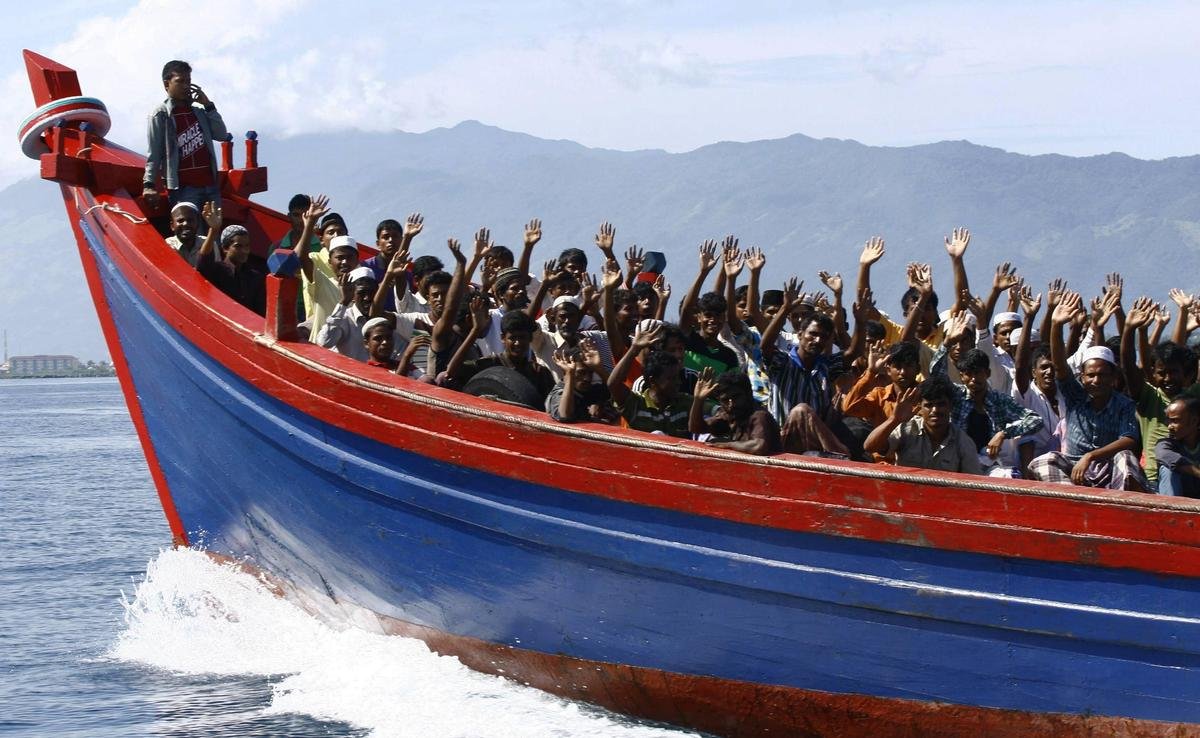
Seeking safe harbour: The refugees being transported by a wooden boat to a temporary shelter in Krueng Raya, Aceh Besar, Indonesia, on April 8, 2013. The port has been a major landing point and temporary shelter site over the years.

Photo:
The New York Times
Fleeing the inferno: Rohingya refugees flee as fires in Myanmar, allegedly started by the military, burn in the background, near Bangladesh in 2017.

Photo:
Reuters
Paddling into exile: Rohingya refugees cross the Naf River on an improvised raft to reach Bangladesh on November 12, 2017.

Photo:
Reuters
Longing for justice: Rohingya refugees watch the live announcement of the verdict in a genocide case against Myanmar on November 19, 2026

Photo:
Reuters
The agony of loss: Hamida, a Rohingya refugee, weeps as she holds her 40-day-old son, who died after their boat capsized before reaching the shore in Teknaf, Bangladesh, on September 14, 2017.

Photo:
Reuters
A weary survivor: An exhausted Rohingya refugee touches the shore after crossing by boat through the Bay of Bengal at Shah Porir Dwip, Bangladesh, on September 11, 2017.

Photo:
AFP
Recalling the pain: Rohingya refugees make their way to a ceremony marking the second anniversary of the military crackdown in Myanmar, at a camp in Bangladesh in 2019.

Photo:
AP
Hostile shores: Rohingya refugees disembark on Sumatra’s north coast, in Indonesia, in November 2023. About 240 refugees made two attempts to land but were turned away.

Photo:
Getty Images
Bare essentials: Families carrying their belongings as they walk along the Bangladesh side of Naf River in 2017, while fleeing from Myanmar.

Photo:
AFP
A cold reception: Newly arrived Rohingya refugees are stranded on a boat after the local community, having provided them with food and water, decided not to allow them to land in Pineung, Aceh province, Indonesia, on November 16, 2023. The year 2025 was the deadliest on record for Rohingya refugees fleeing by sea, with nearly 900 reported dead or missing in shipwrecks, the United Nations said in 2026.

Photo:
AP
No place is home: Refugees being transported aboard a naval ship to an isolated island in the Bay of Bengal, in Chittagong, Bangladesh, in December 2020.

Photo:
AFP
A young victim: A child cries in the Thyangkhali refugee camp at Cox’s Bazar in Bangladesh on November 29, 2017.

Photo:
Reuters
Rare reprieve: A Rohingya refugee takes a selfie as the verdict is translated for the crowd watching the live announcement by the International Court of Justice.
Published – November 22, 2026 09:12 am IST


