







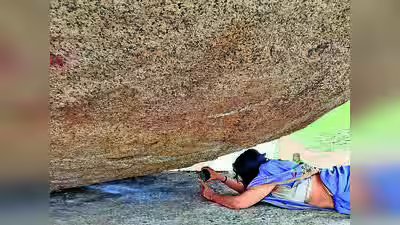
Vinita Sidhartha, 59, is a hardcore gamer, but not the kind you’re thinking of — the pale teen hunched over a console, waiting for the latest update to drop. Vinita is the kind who trudges across thousands of square feet of temple floors to find games. She crawls behind foliage on a university campus, and reaches into the less than six-inch gap under the 250-tonne Krishna’s Butterball in Mamallapuram.The gamer’s latest research, published last month in the CSMVS Journal, gives clues to the age of the game of ‘dahdi’ or ‘three nested Squares’, which she found etched at the entrance of the Saluvankuppam temple near Mamallapuram, unearthed by the 2004 tsunami. “Dahdi resembles ancient European games such as ‘nine men’s morris’. Games such as these have also been found etched in church parapets in Spain,” says Vinita.So, why does she hunt these games down? “Why wouldn’t anyone?” says Vinita.“They open up the most fascinating world. Temples were once social and cultural hubs. These ancient boards offer clues to the everyday lives of people who gathered there .”Vinita isn’t a one-of-a-kind game seeker. R G Singh and Dharmendra Raghu of Ramsons Kala Pratishtana, a not-for-profit cultural trust in Mysuru, have spent two decades tracking down forgotten games. Their latest find, in Dec 2025, was the game of ‘navakankari’ (also a version of nine men’s morris) etched into the stone near the entrance gopuram of the Jalakanteshwara temple in Vellore. They have documented board games on the floors of more than 100 temples, mostly in Karnataka but also in Odisha, Maharashtra, Uttar Pradesh and Tamil Nadu.“When we search for these games on temple floors, people stare at us like we are mad,” says Dharmendra. “Because while they are busy looking up to admire the architecture and deities, they see us looking down, photographing the floor, occasionally letting out a whoop of delight.”Game graffiti is not found everywhere in a temple, says Dharmendra. “We usually find them on elevated platforms or in shaded spots where people could sit comfortably. In forts, we find games at vantage points that have a 360-degree view. Clearly, the guards who kept watch passed time with a game,” he says. At Salem Fort, Vinita found two boards carved into a small lookout shelter.Sometimes, though, the placements are puzzling. At the Erikatarama temple in Madurantakam, Vinita found a game etched on the compound wall. Her explanation is that a horizontal stone was reused during renovation. At the Jawaharlal Nehru campus in Delhi, she found a game behind the foliage and later came to know that the spot was originally a quarry.Under the Butterball, where she slid her phone with great difficulty, Vinita found ‘dahdi’, a game she has seen in other temples. “Nobody could have gone down there, where their hands can’t even reach, and carved games to play,” she says. “This told me the games were etched before the Butterball came to be there, which, according to legend, was perhaps before the 12th century.”She also believes that many boards were cut by artisans who travelled for temple construction or renovation, which would explain why similar games appear across the country. “When you see some of the boards, you realise the deep cut lines could not have been done without skilled hands and tools.”Working out the rules of some of the games is a challenge, says Singh, because one board can accommodate several games. The team draws on anthropologists’ records of traditional games, rules noted by British writers, texts such as ‘Krida Kausalya’ and ‘Manasollasa’, and recent academic research. “But for many everyday games, the rulebook exists in people’s heads, passed from one generation to another,” he says.V Balambal, former professor of history at the University of Madras, author of ‘Folk Games of Tamil Nadu’, says temple games such as pallanguzhi and its variants have been used to teach arithmetic and develop mental skills in parts of Africa and the West Indies. “I have conducted several workshops on it for children with special needs and those who are visually impaired. It is an inclusive game,” she says. “Paramapadam, which inspired modern ‘snakes and ladders’, was meant to teach about virtue and vice. Honesty and kindness take you up the ladder, while lying, stealing and greed bring you down. Modern-day versions do not incorporate these lessons.”In the game ‘aadu puli attam’, says Vinita, 15 goats have to work together to overpower three tigers. “It’s very much a community approach, how a community can overcome the biggest hurdles when they band together.”Most people at the temple today don’t know about the games, says Vinita. Archaeologists, too, sometimes mistake the markings for architectural plans before recognising them as games.Autorickshaw and taxi drivers near temples in Karnataka and Tiruvannamalai told Singh and Dharmendra the rules of games like ‘chowkabara’, which they play while waiting for passengers. In Hampi, they found women using leaf sap to draw boards on marble temple floors.Vinita believes traditional games vanish faster than classical art forms because children are losing the ability for unstructured play. “Rather than playing chess or cricket, they go for chess class or cricket class. The importance of play for the sake of play, not just to learn, has gone.” She has spent 25 years reviving India’s traditional games though Kreeda, the organisation she founded. She also conducts workshops at school and has an experience centre. Singh’s trust works through crafts and in classrooms to revive the games. “We worked with dhurrie weavers to explore how their techniques could make game boards,” he says. “We wanted to add a new dimension to traditional crafts.” They have also trained teachers to introduce the games to children.But for both, the hunt is far from over. “I’ve found many, many boards. I’m not sure what the games or rules are, but I’m determined to find out,” says Vinita. Meanwhile, Singh and Dharmendra are racking their brains over the two arrowheads pointing towards each other that they discovered recently etched on a temple floor in K R Nagar near Mysuru.“We have never seen anything like it. We’re now trying various permutations and combinations to settle on what we think the rules are,” says Singh.Games at a glanceDahdi (Three Nested Squares) | Found at Mamallapuram, Saluvankuppam and other temples; resembles the Nine Men’s Morris family of games in Europe, where each player has nine pieces and tries to form a row of threePallanguzhi | Traditional counting game of Tamil Nadu, resembles the Mancala games of AfricaAadu Puli Attam | Three tigers against 15 goats, which must cooperate to trap the tigers. The tigers must avoid being trapped, while the goats must close in without leaving themselves exposed