








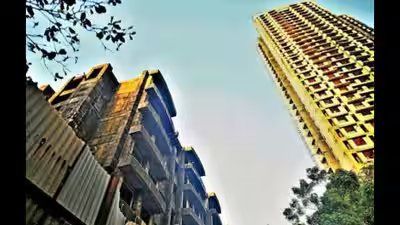
CHENNAI: Tamil Nadu has raised the permissible height threshold for non-high-rise buildings from 18.3 metres to 19.5 metres, relaxed parking requirements for IT offices and expanded the range of developments allowed in Chennai’s restricted aquifer recharge area, as part of a series of amendments to the Tamil Nadu Combined Development and Building Rules, 2019.“One of the key changes is to the height of non-high-rise buildings. As the height has been increased, developers can plan higher ceiling and can create aesthetically planned buildings, and this will help control urban heat too. We have also made accessibility compliance mandatory. There should be specific provisions for persons with disabilities, elderly people and children must be complied with before a completion certificate is issued,” said Kirlosh Kumar, secretary of the housing and urban development department.The amendments, issued on Oct 26, also introduce changes to commercial zoning, hotel dormitories, swimming pools and accessibility provisions for persons with disabilities, elderly people and children.A key change concerns the classification and regulation of buildings up to 19.5 metres. The revised rules update height references across several categories, including non-high-rise, institutional and transport terminal buildings. However, the applicable road-width, floor space index (FSI), setback and other planning requirements will continue to govern individual projects.The govt has also revised provisions governing land use along wider roads. In designated residential and primary residential zones, sites abutting and gaining access from roads at least 12 metres wide will be deemed to have commercial zoning in the specified circumstances. For areas outside the Chennai Metropolitan Area, the corresponding threshold under another amended provision is 9 metres. “This will reduce the number of reclassification files,” said a CMDA official.Besides, IT offices will need fewer parking spaces under the revised norms. The requirement has been reduced from one car space for every 50 sq metres of floor area to one for every 75 sq metres. The two-wheeler parking requirement has been reduced from one space for every 25 sq metres to one for every 50 sq metres. “We have made it on a par with norms for commercial buildings,” he added.The amendments also significantly alter development parameters in Chennai’s restricted aquifer recharge area. The permitted height for specified non-high-rise residential and commercial buildings has been increased from 9 metres to 14 metres, while the limit of six dwelling units is retained for the covered category. “Earlier G+1 building were allowed, but after the amendment another floor can be added,” he said.The revised list of permissible developments includes hostels and dormitories up to 500 sq metres, working women’s hostels, old-age homes, specified government offices, restaurants and tourism-related developments, subject to prescribed conditions. Hotels, beach cottages and recreational activities on plots of at least one hectare are also covered by specified provisions.Other changes prescribe dormitory facilities for drivers at hotels and lodges, define open kitchens and revise swimming-pool deck and clearance requirements. Accessibility provisions have also been strengthened, with specified compliance required before a completion certificate is issued.The high-rise FSI norms remain unchanged at 2.0, 2.5 and 3.25 for roads measuring 12, 15 and 18 metres respectively, with maximum plot coverage continuing at 50%.Amendments in a nutshellBuilding height: Threshold raised from 18.30m to 19.50m in specified provisions.– IT office car parking: One space for every 75 sq m, up from one for every 50 sq m.– IT office two-wheeler parking: One space for every 50 sq m, up from one for every 25 sq m.– Aquifer recharge zone: Permitted height for specified non-high-rise buildings increased from 9m to 14m.– Residential units: Six-dwelling limit retained for the specified category in the restricted aquifer zone.– Commercial zoning: In designated residential and primary residential zones, qualifying sites on roads at least 12m wide may be deemed commercially zoned under the amended provision.– Outside Chennai: Qualifying sites on roads at least 9m wide may be deemed commercially zoned under the specified provision.– High-rise FSI: Unchanged at 2.0 for 12m roads, 2.5 for 15m roads and 3.25 for 18m roads. Maximum plot coverage remains 50%.– Driver dormitories: One bed space with moving area around the bed for each car-parking space required for guest rooms; one separate toilet and bathroom for every eight beds or part thereof.– Open kitchens: Defined as kitchens opening directly into living, dining or other habitable spaces, without physical separation between the cooking and living areas.– Accessible washrooms: Minimum clear floor space of 900mm × 1,200mm at the wash basin; 480mm clearance beneath it for knee space; basin height of 750–850mm.– Toilet grab bars: Required on both sides, positioned 300–350mm from the toilet’s centre line.– Swimming pools: For single-dwelling pools, minimum 1.2m between the pool and deck area; at least 1m setback from adjacent structures or site boundaries. Other buildings require decks at least 3m wide on the longer side and 1.2m on the shorter side.– Pool clearance: At least 3m of deck between adjacent pools and 2m of unobstructed overhead clearance.– Accessibility compliance: Specified provisions for persons with disabilities, elderly people and children must be complied with before a completion certificate is issued.