








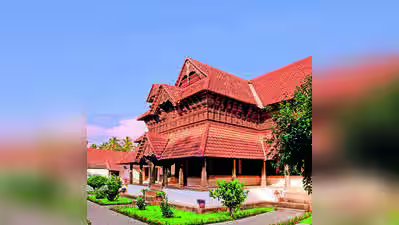
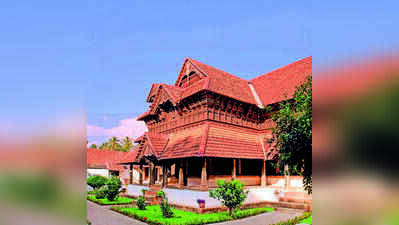
One of the largest wooden palaces in Asia, the 17th-century Padmanabhapuram Palace in Kanyakumari district, is a monument protected and maintained by the department of archaeology, Keralam. With six lakh visitors a year — more than 1,000 a day during peak seasons — the Travancore-era heritage structure in Padmanabhapuram near Thuckalay is buckling under the pressure of tourism.The department, which carried out restoration work for 2.3 crore at the palace over the past two years, including a revamp of its museum, is now considering an online ticketing system for visitors. A limited, slot-based approach could be the first step towards regulating footfalls and reducing the wear and tear endured by the structure.Officials say the Padmanabhapuram Palace, like other heritage monuments in India, needs to be protected from indiscriminate tourism. The palace was constructed using locally-available materials such as lime mortar. The floor was laid out using a mixture of herbs and guarded ingredients. “In its heyday, the palace, which has more than 15 distinct structures, could withstand the load exerted by 150-odd royals, attendants and a posse of civilians. Over the years, the carrying capacity of any such structure tends to diminish. Today, hundreds of visitors access the premises daily, many of them unmindful of the restoration work that has helped keep this more than 400-year-old palace in good stead,” says E Dinesan, director of the department of archaeology, Keralam.On average, over the past 10 years, the department has spent 1 crore annually on conservation work as well as on improving security, surveillance and visitor amenities at the palace which earns 2 crore annually from ticket sales. “Phase 1 of the restoration of the oldest structure — the homappura, a single-storey, double-courtyard building where homams were performed — was completed at a cost of 60 lakh. We also received administrative sanction of 68 lakh for the ongoing restoration of Puthen Kottaram, a relatively new structure. Apart from this, 60 lakh has been earmarked for restoration work at Thekkae Kottaram, a residential complex to the south of the palace. A proposal has been sent to the Keralam govt and we are awaiting administrative sanction,” says Dinesan.Almost all areas of the palace have been opened to the public, except the Uppirikka Malika, which houses a mural pagoda and served as the prayer chamber of the royals. The director says that more than a decade ago, the Keralam govt had approached Unesco to nominate the palace as a potential World Heritage Site. However, it was informed that certain zoning regulations — including buffer-zone mandates relating to construction, land use and resource extraction — applied to such structures.The archaeology department has jurisdiction only over the 6.5-acre grounds on which the palace is situated. Everything outside the palace walls falls under the jurisdiction of the Tamil Nadu govt. This includes the assortment of curio shops, eateries and commercial establishments that have sprung up outside the monument, as well as the remains of the 284-year-old Kalkulam fort adjoining the palace, which is now in a state of ruin.“A few decades ago, the Tamil Nadu public works department (PWD) was entrusted with the maintenance of the fort, which covers an area of 186 acres. But now, it is in a precarious state, as the fort is not protected by either the state or the Central govt. Some portions have been demolished, while others have been lost to encroachments. As there are roads and settlements close to the fort wall, there is also a looming risk of collapse,” says D Dayalan, former director, Archaeological Survey of India, and archaeological adviser to the Tamil Nadu state department of Archaeology.Kanyakumari district has several historical structures in a dilapidated state, including forts, temples, churches and monuments built during the Travancore era and the years of Dutch presence in the region. About 6.5km away, in the panchayat town of Eraniel, is another Travancore-era monument: Eraniel Palace, whose ruins lie neglected. This palace is under the control of the Tamil Nadu govt.The protected monuments in the region also include the Udayagiri fort in Puliyoorkurichi, first constructed with mud by the Venad king Vira Ravivarma (1595-1607 CE) in 1600 CE. It was later reconstructed with granite by Marthanda Varma (1729-1785 CE) under the supervision of the Dutch lieutenant of the Travancore army Eustachius De Lannoy in 1744 CE. The biodiversity park within the fortification comes under the TN forest department, while the historic structures at the fort including a chapel that houses De Lannoy’s tomb are protected by the TN archaeology department.“It would be ideal if the state govts could work together to bring neglected sites under the banner of a unified heritage zone to promote their shared histories. Locals interested in the upkeep of specific structures can contribute to the National Culture Fund and urge the govt to work on them. Several temples in Tamil Nadu including those in Thiruparankundram and Palani are being restored, for which the HR&CE department has engaged private funding,” says Dayalan.A royal historyThe Padmanabhapuram palace was constructed within the ancient 185-acre Kalkulam fortifications. It was the administrative headquarters for the Venad kingdom. The Kalkulam forts were established around 1600 CE, during the reign of Iravi Varma KulasekharanAround 1750, the palace and fort were rebuilt by Anizham Tirunal MarthandaVarma. The palace was submitted to the royal family’s patron deity, Sree Padmanabha Swamy and hence came to be known as PadmanabhapuramIn 1934, Sree Chithira Tirunal Balarama Varma, the last Maharaja of Travancore,Sethu Parvathi Bayi, the Queen Mother, and Dewan Sir C P Ramaswami Aiyer, collectively helped bring the palace to the notice of J H Cousins, the art advisor to Travancore govt and R Vasudeva Poduval who headed the archaeology department. The palace was converted into a museum complex in 1935As per the state reorganization settlement in 1956, 6.5 acres of the palace complex was retained under the custodianship of Keralam govt. The palace is a protected monument of the Keralam department of archaeology