







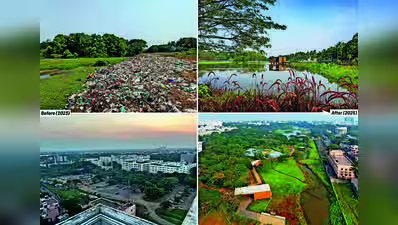
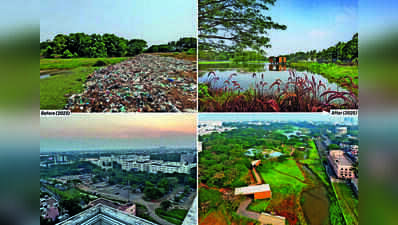
Looking at the Dr M S Swaminathan Wetland Eco Park in Porur with an ecosystem of 68 bird species, including the migratory grey and black-crowned heron, and eastern egret, along with butterflies, dragonflies and frogs, one would never imagine this was once a garbage dump.This transformation was discussed at a session organised by the M S Swaminathan Research Foundation (MSSRF) on Thursday as part of World Water Week 2026. The 16-acre park, said to be India’s first sponge park, was developed to show how urban open spaces can be transformed into nature-based infrastructure that absorbs, stores, and recharges rainwater while supporting biodiversity. The project was conceptualised and designed by Sponge Collaborative for Chennai metropolitan development authority (CMDA), which sees such landscapes as an alternative to cities relying solely on concrete stormwater infrastructure.“When we arrived at the site in 2023, half of it was impervious asphalt, and the other half was filled with garbage,” says Manushi Jain, co-founder, Sponge Collaborative.“We reimagined the space that could be given back to the community. We wanted to remain true to the site’s topography and geology while also educating people about why wetlands are critical infrastructure,” she says. The team retained 100 mature trees on the site and introduced more than 15 native wetland species. The landscape was redesigned with sedimentation ponds for capturing stormwater runoff, bioswales for filtering the runoff, aeration ponds to add oxygen and circulate water to break down waste, and phytoremediation ponds to treat and hold stormwater naturally.The idea was inspired by the sponge city movement in China and the work of landscape architect Dr Kongjian Yu, says Praveen Raj, co-founder of Sponge Collaborative. “The project was designed in a way where we decided to work with nature rather than try to fight it.”The park collects runoff from a 150-acre catchment comprising residential neighbourhoods and a university campus. It can hold 30,000 cubic metres of water at any given time, allowing water to be slowed, treated, stored and gradually released into the drainage system after storm events. “During intense rainfall, parts of the landscape are designed to temporarily flood while critical infrastructure remains protected. The park also doubles as a public space, with play areas, an open gym, seating and shaded areas,” says Praveen.He adds that land-surface temperature monitoring showed that an unshaded parking lot nearby could reach 51°C, while the park was 36°C. “We are working to replicate this approach in Nagapattinam, Bengaluru, Nasik, Warangal, three coastal cities in France, as well as in Mauritius,” says Manushi.