









Mannar
For about a decade now, successive governments in Sri Lanka have sought to tap Mannar’s strong winds to power the island’s transition to green energy. But renewable energy projects — existing and proposed — have left local communities increasingly fearful about the possible impact on their environment and livelihoods.
Residents in villages across Mannar district, on Sri Lanka’s north-western coast, report recurring flash floods in recent years, growing demand for land from both the government and private companies, the constant noise from wind turbines near their homes, and a shrinking fish catch. They fear that the growing number of renewable energy projects could be contributing to these changes and impacting the environment. If decades of war meant contending with deaths, disappearances, and displacement, the post-war years have forced another struggle upon the people of Mannar — for development that meets their needs. The renewable energy projects are yet to speak to them.
“We are often asked if there is scientific proof linking these changes to the renewable energy projects. Sometimes, everyday lived realities of people reveal more than science does,” said Fr. G. A. Arulraj Croos, Director, Caritas Valvuthayam, the social arm of the Catholic Diocese of Mannar. “It is a survival issue, not merely an environmental concern.”
Residents have no scientific evidence to substantiate their claims so far. But they contend that the authorities, too, have not shown them research that rules out any impact on their environment. “We can only tell you what we see and experience. The course of waterways in our village has changed. We can see the coastline eroding,” said a resident of Arippu village who leads a local fishermen’s association. “Following land acquisitions in the district to accommodate wind turbines, rainwater does not drain out like before. We are frequently experiencing floods,” he said, requesting not to be named. “They [the authorities] think we oppose everything”.
Mannar district spans the country’s north-western mainland and a small, dolphin-shaped island connected to it by a causeway. It is on this island that Talaimannar, Sri Lanka’s closest point to India, is located – once connected to Rameswaram by a short ferry ride across the Palk Strait. It is also here that some of the strongest winds on the island blow.
Harnessing the winds
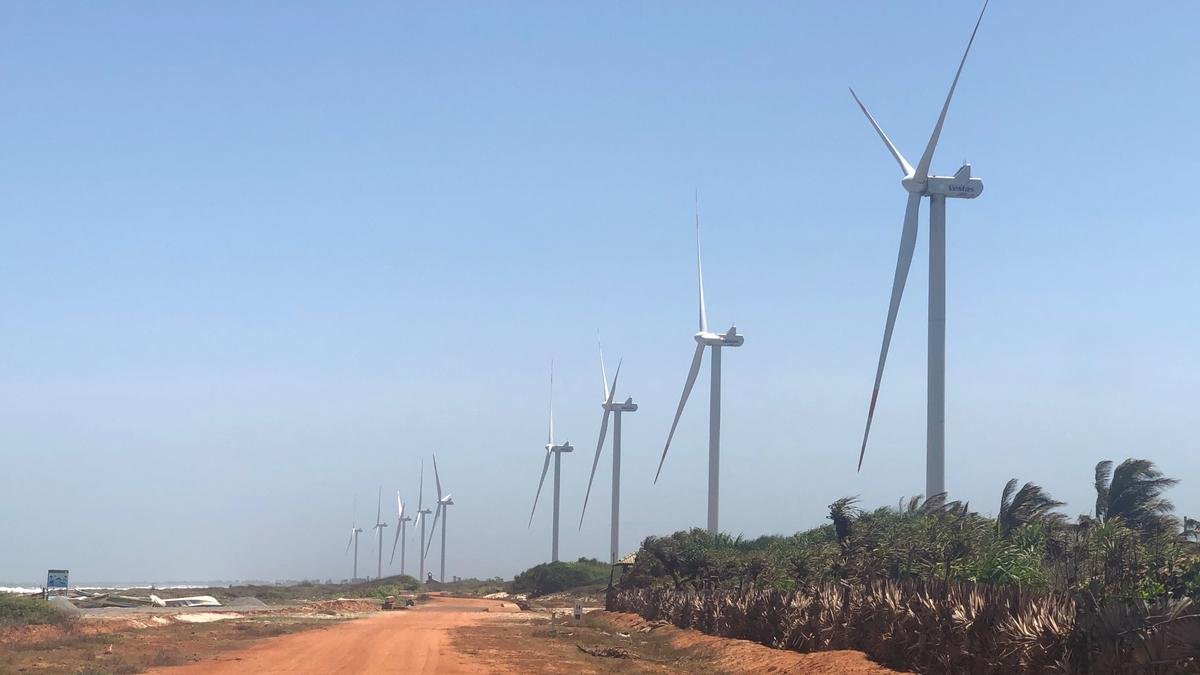
Thirty towering turbines bearing the name of their Danish manufacturer, Vestas, line the southern coast at the Ceylon Electricity Board [CEB]’s Thambapavani wind farm — Sri Lanka’s first large-scale wind project. Conceived in 2018 to add 104 MW to the national grid, the nearly $200-million project was financed through an Asian Development Bank loan and officially inaugurated in late 2020 by then Prime Minister Mahinda Rajapaksa, when his brother Gotabaya Rajapaksa was President.
Less than a year later in October 2021, Adani Group chairman Gautam Adani flew to Colombo and met Mr. Gotabaya to discuss the Colombo port terminal project that Adani Ports was executing. He also discussed potential renewable energy projects and visited Mannar with his team in a Sri Lanka Air Force chopper to see one of the island’s most resource-rich regions.
Five months later, the CEB signed an agreement with Adani Green for a $500 million, 500 MW wind power project. The Rajapaksa administration approved the investment without a competitive bid, triggering many questions and a prolonged controversy. The succeeding Ranil Wickremesinghe administration, too, through the Board of Investment, cleared the wind power project in Mannar and nearby Pooneryn in February 2023. One of the biggest FDIs to come into the island after a devastating economic crisis, the wind farm project soon faced legal challenges from environmental groups and local communities. It was in the spotlight until Adani Green pulled out in February 2025, even as President Anura Kumara Dissanayake’s government resisted the company’s “excessive” power purchasing tariff. Adani Green left, but locals’ apprehensions remain.
Green energy ambitions
Sri Lanka aims to meet 70% of its total energy requirement through renewable sources. The Indian government is executing a hybrid renewable project across Delft, Analathivu, and Nainathivu islands, off the Jaffna peninsula, with an $11-million grant.
Colombo has identified Mannar as a key source of wind energy, given its potential. In the wake of persistent protests from locals voicing fears about the apparent environmental impact of the projects, including their impact on a key bird corridor that draws seasonal flamingos, the Cabinet decided late last year to halt all new wind power projects on Mannar Island.
President Dissanayake instructed authorities not to proceed with future projects “without the consent of the people living on Mannar Island”. Meanwhile, the government is pressing ahead with projects already decided upon, with local energy firms Hayleys Fentons, WindForce, and Vidullanka winning bids to execute wind farm projects in Mannar.
Residents are reassured that new projects are on hold, but they do not know what to make of ongoing projects. They voice concerns about the possible tremors from turbines and worry that these might affect pregnant women and children. When information is scarce, the line between verified reports and vague rumours blurs.
“If authorities are not transparent, you cannot prevent speculation and scaremongering,” said M.A. Ameerun Nisha, a member of the local council or Pradeshiya Sabha. “The government needs to tell the local communities what these projects are about, how much land they need, what benefits they will bring to the local community and what the environmental risks are.”
Those active in local campaigns against wind power projects say they were not consulted. “This government opposed the Adani project not because of the environmental risks that we locals raised, but because they found the tariff high,” said A. Robert V. Peries, an engineer in Mannar. Activists like him understand the importance of switching to renewable energy, especially in the wake of the global energy crisis. But the irony of a country’s push towards green energy possibly threatening local environments is hardly lost on them. “When we flag unusual flooding, a fall in our harvest or a drop in fish catch, authorities must take note,” Mr. Peries said.
Sri Lanka’s total installed energy capacity is 6,345 MW, with a peak demand of about 3,000 MW, and most of the country’s demand is met by hydropower. The government aims to add 300 MW from renewable energy sources to the national grid by the end of next year, according to Deputy Minister of Energy Arkam Ilyas. Pointing to the “economic strain” from energy imports, Mr. Ilyas told The Hindu: “Some months we are spending nearly 30% of our foreign reserves to import fuel. Our aim is to reduce it to 10%.”
On the apprehensions of locals and environmental activists, he said: “We are aware of their concerns and are taking them on board. I have been visiting the villages to better understand their issues, so we can raise awareness and respond constructively. We are working to ensure that the projects benefit locals by generating employment and enhancing development prospects.”
Senior human rights activist and chairman of the Mannar-based NGO Organization of People for Engagement and Enterprise Raga Alphonsus pointed to rapid changes in the district amid a growing push for aquaculture, sand mining and wind power projects. “There are many questions regarding how consent from communities is obtained. Also, while there are individual environmental impact assessments, we do not know the cumulative impact that all these projects could have on our environment,” he said, calling for a comprehensive study of risks.
Published – August 25, 2026 01:38 am IST

