









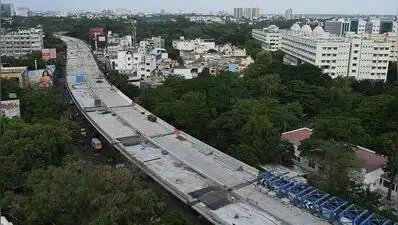
The 3.2km Teynampet-Saidapet flyover on Anna Salai will miss its Sept 2026 deadline as the state highways department has run into a major design snag midway.The ₹621-crore flyover now needs a “scope change” as the department has realised that it cannot proceed with the original pillar design on the narrow Nandanam-Teynampet stretch. The realisation dawned on the officials only after more than 80 pillars, girders and 50 spans were constructed or placed on the Saidapet-Nandanam stretch. The revised deadline is now Feb 2027 — but this too looks uncertain.The project began in Jan 2024. Earlier, the highways department justified the high project cost by citing its high-tech prefabricated steel structures, which are being brought directly to the site from other states. The structures can be mounted on Metro station foundations, allowing faster construction than conventional concrete flyovers.But midway through the work, officials found that the DPR did not accurately capture the alignment of the existing Metro foundations on Nandanam-Teynampet stretch. Unlike other sections, the central foundations here are not in a straight line.“The central foundations of the Metro were not straight from Nandanam to Teynampet. DPRs will have technical information, but the reality at the work site will be different. If we place central pillars on the existing foundations, they will not be straight and will have slight deviations making the flyover curved,” an official said.The department found that the road width varies sharply along this stretch, with just 28m on Cenotaph Road, 32m near Arivalayam, compared with 36m at DMS and 40m at Saidapet. Placing central pillars on the narrow sections, officials said, would create severe traffic disruption.The department submitted a change-of-scope proposal earlier this year to replace the central pillars with portal pillars. The revised scope was approved only last month. Officials said the change will not add to the project cost.Under the revised design, 45 pillars will come up at the Teynampet and Nandanam Metro stations, with CMRL providing foundation support on the station walls. Portal pillars will rise from both sides of the pavements and be fitted into the stations’ diaphragm walls. “Central pillars will have spans of 30m length, but in portal pillars, we can place more spans of 11m in shorter intervals,” the official said.“Steel pillars will be erected on both sides of the pavements and connected through a central pillar across the road. The girders will then be placed on them,” the official said. Highways has so far erected about 88 pillars and placed spans (structures connecting two pillars) on 50 of them. A total of 131 spans have to be placed.The delay is already being felt by motorists, particularly at the major diversions: Theagaraya Road in T Nagar and Cenotaph Road. Both stretches have uneven roads riddled with craters, making riding difficult and throwing two-wheelers off balance.