








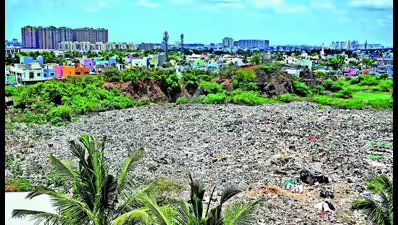
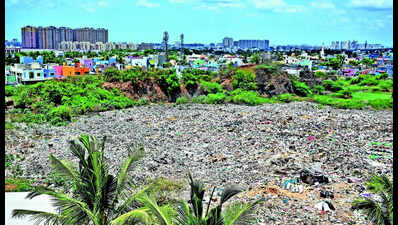
Chennai: Sandwiched between GCC and Tambaram corporation limits, Medavakkam’s population has grown from 40,312 in 2016 to 94,665 in 2026. The village panchayat has emerged as one of the most sought-after residential destinations, thanks to its proximity to OMR, Velachery, Pallavaram and Tambaram. No wonder, the per square feet rate for a residential apartment has breached the ₹6,500-mark from ₹3,250 in 2021.But, civic infrastructure has failed to keep up with this development. Here are the few civic woes of South Chennai’s fastest-growing residential localities:RoadsMedavakkam has 537 roads maintained by the St Thomas Mount block. Many interior roads, however, are full of potholes, making commuting difficult. According to panchayat records, 185 roads were laid over the past five years at a cost of ₹19.69 crore. Officials estimate that an additional ₹12 crore is required to lay 75 more roads.Most traffic passes through the 16-km Velachery–Tambaram arterial road, of which nearly 5km falls within Medavakkam.Last year, the highways department began road-widening work near the Medavakkam Main Road junction. But, the project has remained incomplete, causing severe traffic congestion along a stretch of nearly 4km. It takes more than 30 minutes just to cross the bottleneck. M Thirunavukarasu, divisional engineer, highways department, said, “We have been regularly conducting encroachment clearance drives with traffic police. Congestion is mainly caused when people visiting nearby commercial establishments park their vehicles by the roadside,” he said. “We will enforce regulations and penalise violators.”Waste ManagementUnlike areas under corporation limits where garbage is collected daily, panchayat workers collect waste only twice a week in manyneighbourhoods. Secretary of SSJ Nagar Residents Welfare Association Mathi Kumar said, “Garbage collection is done haphazardly and there is no segregation at source. In areas such as Surya Nagar and Sathya Sai Nagar, waste is dumped in open spaces and not cleared for a week.”The locality generates some 80 tonnes of waste every day. A pond that supplied water has now been converted into an eight-acre dumpyard. Heaps of rotting meat, vegetables and plastic waste pile up, posing a health risk to locals.“We have established a waste segregation plant at the dumpyard at ₹25 lakh. Waste is segregated there before being transported,” said M Venkataragavan, commissioner and block development officer of St Thomas Mount panchayat union. “We do not have any other place to store the garbage temporarily. All waste generated here is eventually taken to the Appur landfill for biomining,” he said. Water supply and stormwater drainAt present, Medavakkam requires an estimated 13.5 million litres of water a day. Most households depend on private water tankers and tractors. Residents pay around ₹600 for 2,000L of water and up to ₹2,500 for 6,000L.Though pipelines have been laid in some areas under the Jal Jeevan Mission, a resident, S Ravi Kumar, said they had not received water through them yet. The place lacks underground sewage network, forcing households to depend on septic tanks. In several areas, sewage finds its way into stormwater drains before reaching lakes, he said.“Around 60km of stormwater drains have been laid over the past five years at ₹2.5 crore. Steps are being taken to ensure piped water supply to residents,” Venkataragavan said. LakesMedavakkam has three big lakes — Periya Eri, Kalleri and Sitheri (Chinna Eri).Periya Eri, once spread across nearly 200 acres, now covers only 50 acres. The water resources department, with CSR support from a private foundation, restored the lake last year at ₹1 crore. The lake now has a 1.5-km walkway. Residents, however, say nearly 50 buildings have encroached upon the lake bunds.Kalleri, once spread across 30 acres, has shrunk to six acres. It serves as a natural channel carrying surplus water from Periya Eri to Sitheri. Today, it is filled with water hyacinth and sewage.Sitheri, the last lake in the chain, connects a natural channel that carries surplus water to Narayanapuram Lake, Pallikaranai marshland and Buckingham canal. The channel, though, is clogged with garbage and sewage, preventing the free flow of water.According to an IIT study conducted last year, Periya Eri recorded a dissolved oxygen (DO) level of 5.11 mg/L, indicating moderate water quality. Kalleri was classified as heavily polluted with high dissolved oxygen level of 10.19 mg/L. Chinna Eri was the most polluted lake in the survey, recording a dissolved oxygen level of just 0.14 mg/L.“Large-scale encroachment of the bunds and catchment areas are the biggest problem in Sitheri and Kalleri. The department cannot begin restoration work unless these encroachments are removed,” R Arunmozhi, executive engineer of WRD, said. “We have completed land surveys, identified encroachers and issued notices. Necessary steps will be taken soon.”Sholinganallur MLA P Saravanan said they had just begun inspecting the area.